
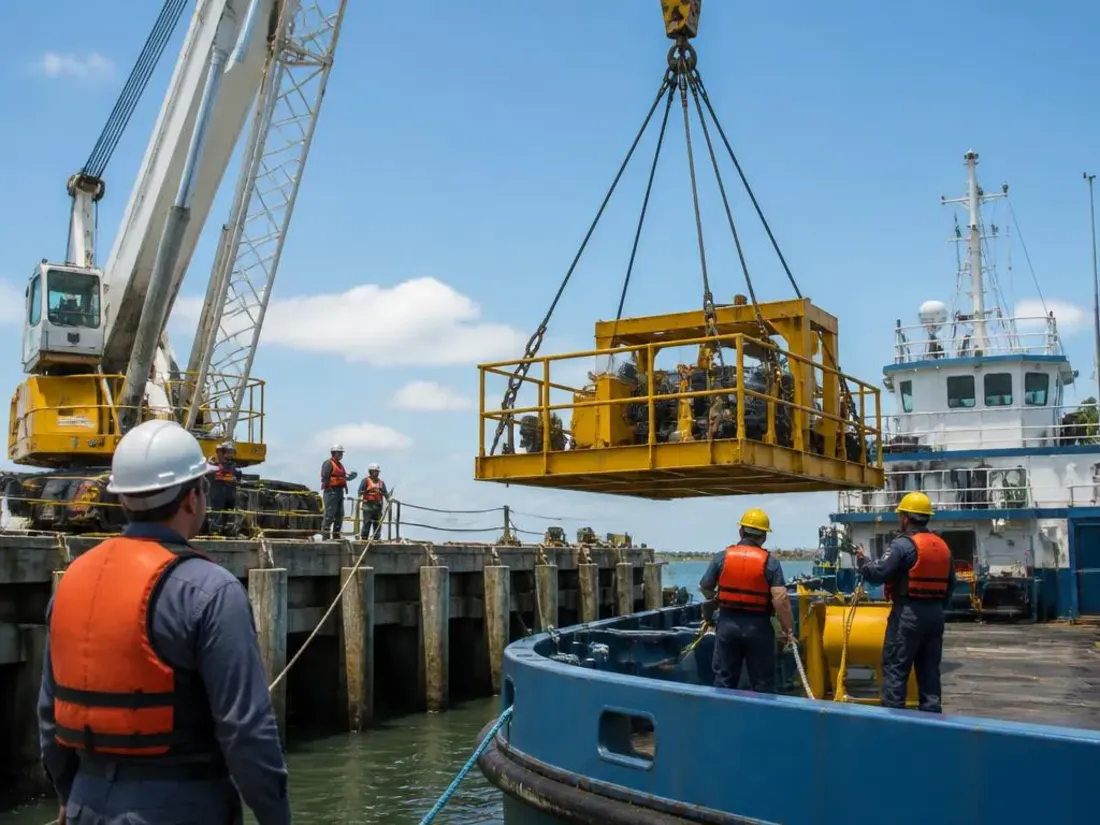
The direct answer: a company other than your employer can face a negligence claim when it owed you a legal duty, breached that duty, and the breach caused your injury. Being present at the site, having a logo on the equipment, or owning the property is not enough by itself. And two things have to be checked before that claim can be relied on: whether the company is legally a third party rather than a borrowing employer with compensation immunity, and what duty it owed you under the law that governs the specific location and work. Establishing who actually controlled the job, the access route, or the unsafe condition is the work of investigation, and that is what this page is about.
The Young Firm represents injured maritime workers in New Orleans, across Louisiana, and along the Gulf Coast. This page is written for offshore workers, dock and terminal workers, and shipyard workers who suspect that a contractor, subcontractor, platform or dock owner, terminal operator, or charterer contributed to their injury. If you do not know the corporate names involved or are unsure of your own legal status as a worker, that does not prevent you from asking for a review. You can contact The Young Firm with what you know now. The broader framework for claims against companies other than your employer is covered in our overview of third-party maritime injury claims.
Can I Sue the Contractor or Property Operator That Contributed to My Injury?
Possibly. Whether you can depends on four things that have to be established, not assumed.
Duty. The company had a legal obligation to you. That obligation may come from its control over the work you were doing, its custody of the premises where you were hurt, a hazard it created, or safety responsibilities it took on by contract or by conduct. The source and scope of the duty depend on the governing law, which is discussed further below.
Breach. The company failed to meet that obligation. It left a hazard in a walkway, failed to fix a condition it knew about, directed a task in an unsafe way, or did not perform a safety function it had undertaken.
Causation. The breach actually contributed to the injury. A hazard that existed but had nothing to do with how you were hurt does not support a claim.
Documented harm. Medical records, wage records, and other evidence establish what the injury cost you.
These are ordinary negligence elements. They are not the same as the standard that applies to a Jones Act employer, which is a distinct body of law owed by an employer to its own seaman employees. A contractor or premises company that is not your employer is judged by the duties that apply to its own role, and those duties should not be assumed to be as broad as an employer's.
A company's own negligence versus someone else's
One distinction matters more than most workers expect. Under general maritime law and under Louisiana law, a company that hires an independent contractor is not automatically responsible for that contractor's negligent work methods. A platform operator that brings in a wireline crew is not usually liable for how the wireline crew rigs its own equipment. Liability for the contractor's method generally requires something more: control the hiring company retained over that work, negligence of its own such as failing to address a hazard on premises in its custody, or another basis for a duty recognized under the governing law. The rules and exceptions vary by jurisdiction, and they have to be checked against the facts. The practical point is that each company's conduct is analyzed separately. Investigation frequently has to look at more than one company, but that does not mean every company at the site will end up responsible.
The threshold question: is this company actually a third party?
Before evaluating a contractor's negligence, a lawyer has to ask whether that contractor is legally your employer, even though it never paid you.
Under the borrowed-employer doctrine, a worker on one company's payroll can be treated as the employee of a second company that actually controlled the work. Courts in the Fifth Circuit weigh factors such as who directed the details of the job, whose work was being performed, whether there was an agreement between the two companies about the arrangement, who furnished the tools and workplace, how long the arrangement lasted, who could end it, and who paid the worker. If a contractor is found to be your borrowing employer, it may be entitled to the same compensation-based immunity your payroll employer has. Under the Longshore and Harbor Workers' Compensation Act, 33 U.S.C. § 905(a) makes the employer's compensation liability exclusive, which means a negligence suit against an employer covered by the Act is generally barred. State workers' compensation laws can have similar effects, including statutory-employer rules that extend immunity up the contracting chain in some situations.
This is a threshold question, not a conclusion. Many contractors on multi-employer sites are genuine third parties. But a claim built on the assumption that a company is a third party can fail if that assumption is not tested early. How a negligence claim against another company fits alongside your compensation or Jones Act rights is addressed in our overview of third-party maritime injury claims.
Who Controlled the Job, the Access Route, or the Unsafe Condition?
On a shared worksite, several different companies can each hold a piece of responsibility: one owns the structure, one has contractual maintenance obligations, one actually supervised the task, one created the hazard, and one knew about the hazard and said nothing. These pieces do not always belong to the same company, and the evidence that proves each one is different.
The table below matches the roles workers recognize to the conduct and records that tend to matter. In every row, the role alone does not create a duty. It only tells you where to look.
| Potential defendant | Conduct worth investigating | Records that tend to matter | Legal caveat |
|---|---|---|---|
| Contractor or subcontractor | Whether it created the hazard, directed the unsafe method, supervised the task, or failed to perform a safety function it had taken on | Work orders, job safety analyses, permits to work, toolbox-talk sheets, supervisor texts and emails, daily reports, the master service agreement and any bridging documents | May turn out to be a borrowing employer with immunity; a hiring company is not automatically liable for a subcontractor's methods; the applicable rules depend on which law governs the site |
| Platform owner or operator | Whether it retained control of the work, knew or should have known of a premises defect, or failed to maintain a condition in its custody | Operating agreements, contractor management procedures, inspection and maintenance logs, hazard and near-miss reports, permit approvals, company-man communications | Ownership does not make the operator liable for every contractor's work method; whether maritime law or adjacent-state law governs the platform must be determined first |
| Dock owner | Whether it had custody of the dock, knew of deterioration or a defect, had a chance to repair it, and whether it controlled the loading or access operation | Lease and custody documents, repair requests, engineering surveys, prior incident reports, maintenance contracts, photographs of the surface or fixtures over time | A lease may shift custody to another company; premises-defect claims are analyzed under the governing law through custody or control, hazard creation, notice where required, and reasonable corrective measures, and whether maritime or state law applies depends on the location and the work |
| Terminal operator | Whether it controlled traffic flow, lighting, equipment staging, housekeeping, or the interface between vessel and shore operations | Terminal operating procedures, gate and yard logs, lighting and housekeeping inspections, stevedore agreements, surveillance footage | A defect in the terminal itself is analyzed through custody and notice; a claim about another company's work generally requires showing the operator controlled that work; a safety rulebook alone establishes neither; governing law depends on the location |
| Shipyard contractor | Whether its crew left hazards in shared spaces, energized or de-energized systems improperly, or coordinated poorly with other trades in the same compartment | Yard work packages, hot-work and confined-space permits, lockout records, trade coordination meeting notes, contractor rosters | Multi-employer immunity questions are common in shipyards; the worker's own status and each contractor's role must be sorted out under the applicable compensation and negligence law |
Contractual control versus actual control
Contracts on maritime jobs often say a great deal about who is responsible for safety. Master service agreements assign responsibility to the contractor. Operators reserve the right to stop work. Safety representatives are stationed on the deck. None of these, standing alone, settles the question of control.
A reserved right to stop work is not the same as directing how the work is done. A safety representative's presence does not by itself mean the representative's company controlled the method that hurt you. Conversely, a contract that assigns all safety responsibility to a contractor does not protect a company that in fact stepped in and told the crew how to do the job. Courts look at what companies actually did, not just what the paperwork said they would do. That is why the investigation has to pair the contracts with the daily records: who gave the instruction, who approved the permit, who was on the radio when the decision was made.
Premises conditions versus work methods
The evidence trail also splits depending on whether the hazard was a condition of the place or a way of doing the work. A deteriorated dock surface, a missing handrail, poor lighting in a terminal yard, or a corroded grating on a platform is a condition. The questions, depending on the governing law, are who had custody or control of the place, whether that company created the hazard, whether it knew or should have known of the hazard where notice is required, and whether it took reasonable steps to prevent or correct it. A crane lift executed without a tag line, a compartment entered before ventilation, or a load staged in a walkway is a method. The questions are who directed it and who was performing it. Many accidents involve both, and each has to be traced to its own company.
Defective equipment raises a third set of questions about manufacturers, suppliers, and equipment service companies, which sit outside this page and within the broader map of third-party maritime injury claims. Guidance organized by workplace rather than by defendant is available in our pages on offshore platform injuries and port, dock, and shipyard injury claims.
A Contractor-Created Obstruction Is Not the Same Claim as a Deteriorated Dock
The examples below are hypotheticals. They are not descriptions of The Young Firm's cases, and they are not predictions of how any claim would come out. They are meant to show how familiar facts lead to different legal questions.
Hypothetical one: the subcontractor's obstruction
A rigging subcontractor finishes a job on a platform's lower deck and leaves a length of wire rope and two shackles across the only route to the boat landing. A worker for a different contractor, carrying tools at the end of a shift, trips and falls down the stairs.
- Actor: the rigging subcontractor that left the material.
- Condition: a hazard created by a contractor's work method and housekeeping, not a defect in the structure.
- Records to seek: the subcontractor's job safety analysis and close-out procedures, the permit for the rigging job, radio or text traffic about leaving material on deck, the platform operator's housekeeping inspection records for that day, and any photographs before the material was moved.
- Open questions: Was the rigging subcontractor a true third party to the injured worker, or were the two crews so integrated that the subcontractor could claim borrowed-employer status? Did the platform operator know the route was blocked and have time to act? Does the platform's location bring Louisiana law into the analysis?
Hypothetical two: the deteriorated dock
A section of timber decking on a river dock has been reported soft for months. A repair request sits in the dock owner's system. A longshore worker steps through a rotted board while guiding a load off a barge and injures a knee.
- Actor: the company with custody of the dock, which may be the owner, a lessee, or a terminal operator depending on the lease.
- Condition: a premises defect, not a work method.
- Records to seek: the lease and any custody or maintenance provisions, the repair request and who received it, engineering or condition surveys, prior complaints or incidents at the same spot, and photographs of the surface.
- Open questions: Who actually had custody? Did that company know or should it have known of the defect, and did it have a reasonable chance to fix or barricade it? If Louisiana law applies, the custodian's responsibility for a defective thing or building is generally analyzed under provisions such as Louisiana Civil Code articles 2317.1 and 2322, which require knowledge or constructive knowledge and a failure to exercise reasonable care. Whether those articles or maritime principles govern depends on where and how the injury occurred.
Hypothetical three: the unsafe instruction
A general contractor's superintendent at a shipyard tells a painting subcontractor's crew to enter a tank before the ventilation the permit required has been running for the required period. A painter is overcome and falls from the ladder.
- Actor: the general contractor whose superintendent gave the instruction.
- Condition: an unsafe work direction by a company that was not the painter's payroll employer.
- Records to seek: the confined-space permit and its conditions, air monitoring records, the superintendent's communications, the coordination schedule for trades in that compartment, and the subcontract's provisions on who controls entry.
- Open questions: Did the general contractor exercise enough control over the painters' work to be a borrowing employer, in which case a negligence claim against it may be barred, or was it a third party that negligently directed work it had no business directing? The same fact that supports a negligence theory, actual control over the task, can also support an immunity defense. This tension is common in shipyard cases and is a reason to have the employment relationship analyzed early.
Shipyard and marine terminal operations are subject to federal occupational safety standards in 29 CFR Part 1915 and 29 CFR Part 1917. Where a specific provision applied to the operation and the regulated employer, a violation may be relevant evidence of what reasonable care required. It does not by itself establish civil liability, and which company was the regulated employer for that provision is itself a question of fact.
Taken together, the hypotheticals show why an owner or operator is not automatically responsible for everything that happens on its property. Its exposure for a condition of the premises depends, under the governing law, on factors such as whether it had custody or control of the place, whether it created the hazard, whether it knew or should have known of the hazard where notice is required, and whether it took reasonable steps to prevent or correct it. Its exposure for a contractor's method turns on the control it retained, its own independent negligence, or another duty recognized under the governing law. Those are different inquiries, and the same company can answer for one and not the other.
When companies blame each other or blame you
Expect it. On a multi-employer site, each company's insurer has an incentive to point at the other companies and at the injured worker. Competing accounts are settled by evidence, not by whoever speaks first or loudest. If a court ultimately allocates fault among several companies and the worker, the method of allocation and its effect on recovery depend on the governing law. Under some rules a worker's share of fault reduces the recovery; under others, above a certain threshold, it can bar recovery entirely. Louisiana's comparative-fault rules have changed, and which version applies depends on the injury date. Which rule governs your claim cannot be assumed and has to be determined for the specific law and date involved.
When Could a Charterer Be Responsible for a Maritime Injury?
Companies hire vessels under different arrangements, and the label "charterer" tells you very little about what the company actually controlled.
- A bareboat (demise) charterer takes over the vessel itself, supplies its own crew, and operates it. For most purposes it stands in the shoes of the owner and is treated as the owner pro hac vice, with the responsibilities that follow from operating the vessel.
- A time charterer hires the vessel and crew for a period and directs where it goes and what commercial work it does, but the owner's crew typically continues to operate and maintain the vessel.
- A voyage charterer hires the vessel for a particular voyage or cargo and generally has even less involvement in vessel operations.
Under general maritime law, a time or voyage charterer is ordinarily responsible for its own negligence within the sphere of activity it controlled, such as selecting an unsafe berth, ordering operations in dangerous conditions, or directing cargo operations it had undertaken to manage. It is not usually responsible for the condition of the vessel or the competence of the owner's crew unless the charter party assigned it those responsibilities or it in fact took them on. A charterer that involved itself in matters beyond the traditional division of responsibility can acquire duties it would otherwise not have. How these principles apply to a given charter depends on its terms, on what the charterer actually did, and on the law governing the claim.
For a worker hurt on or around a chartered vessel, the investigation starts with the charter party itself, then moves to what the charterer actually did: the voyage or operational instructions it issued, its communications with the master and with shoreside contractors, whether it placed its own personnel aboard, and whether it directed the specific operation that caused the injury.
The vessel owner's own responsibilities, and the distinct statutory framework for longshore workers' claims against vessels, are separate topics that sit within the broader map of third-party maritime injury claims. This page addresses charterers only to make one point: the agreement and the actual operation both matter, and neither the label "charterer" nor the label "owner" ends the analysis.
Why the Exact Platform, Dock, or Vessel Location Can Change the Claim
Workers often describe their job with one word: "offshore," "on the dock," "in the yard." The law does not work that way. The exact structure, its location, the work being done, and the employment relationships can each change which law governs, which companies can be sued, and how long you have to act.
Fixed structures versus vessels
An injury on a vessel in navigable waters is generally governed by general maritime law. An injury on a fixed platform attached to the seabed is a different matter. Fixed platforms are not vessels, and for platforms on the Outer Continental Shelf, the Outer Continental Shelf Lands Act, 43 U.S.C. § 1333, provides the jurisdictional framework and, in many situations, directs that the law of the adjacent state applies as surrogate federal law to the extent it is not inconsistent with federal law. For a platform off the Louisiana coast, that can mean Louisiana premises and negligence law governs a claim against a platform operator or contractor, with Louisiana's rules on independent contractors, custody, notice, and comparative fault. Whether OCSLA's applicable-law provision actually reaches a given claim involves a multi-part analysis that courts apply case by case, and it should not be assumed in either direction.
OCSLA also extends Longshore Act compensation coverage to certain workers injured in the course of operations on the Outer Continental Shelf, which in turn brings the employer-immunity and third-party provisions of the Longshore Act into play for those workers.
Docks, wharves, and terminals raise their own questions. Some dock injuries fall within maritime jurisdiction; others are governed by state law. The answer can depend on exactly where the worker was standing and what the work had to do with traditional maritime activity.
Where you live does not decide the question
Living in Louisiana, or leaving from a Louisiana port, does not determine which law governs your claim. What matters is where the injury occurred, on what kind of structure, during what kind of work, and under what employment relationships.
Deadlines are not one number
The time limit for a maritime personal injury tort is set by 46 U.S.C. § 30106, which generally provides three years from the date the cause of action arose. That provision applies to maritime torts. It does not apply to a claim governed by state law under OCSLA or otherwise, and state limitations periods can be substantially shorter. Louisiana's period for negligence claims has changed in recent years and depends on the date of injury. Some defendants, particularly public bodies, may have their own notice or filing requirements. Because the applicable period depends on the governing law, the injury date, and the identity of each defendant, no single deadline can be responsibly stated here. What can be said is that the analysis needs to happen promptly.
Preserving evidence is a separate matter from calculating the deadline. Surveillance footage, work permits, and the memories of witnesses degrade or disappear on their own schedules, which have nothing to do with the statute of limitations. The next section addresses that.
What to Save When You Know the Supervisor or Logo but Not the Company Name
Get medical care first and follow through with it. Nothing on this list should come before treatment, and nothing on it requires you to return to a restricted area, take documents you are not permitted to have, or alter anything.
Write down what you know now
You do not need the corporate names. Record:
- The date and shift of the injury.
- The exact location: which platform, which deck, which dock, which berth, which bay of the yard, which compartment of the vessel.
- The task you were doing and who assigned it.
- The hazard, condition, or instruction that caused the injury, as specifically as you can describe it.
- The names, nicknames, or positions of the supervisors involved and which company you understood each one worked for.
- Logos, hard-hat colors, vehicle markings, or vessel names associated with the companies on site.
- Who maintained or was responsible for the area where you were hurt, if you know.
- Names and contact information for anyone who saw the incident or its aftermath.
Gather what you already lawfully have
- Any incident or accident report you were given or signed, and any statement you provided.
- Text messages, emails, or radio-log screenshots about the job, the hazard, or the injury.
- Photographs or video you or coworkers took of the scene, the equipment, or the condition.
- Your medical records, discharge instructions, prescriptions, and appointment schedules.
- Pay stubs, W-2s, offshore schedules, and anything showing your earnings and the time you have missed.
- Any communication from an employer, insurer, or adjuster about benefits, treatment, or settlement.
Records a lawyer may have to seek
Some of the most important evidence is not in your hands and should not be. Counsel can request or subpoena:
- Surveillance and camera footage from platforms, terminals, and yards.
- Contractor rosters, crew change manifests, and gate logs showing which companies and people were on site.
- Permits to work, job safety analyses, hot-work and confined-space permits, and lockout records.
- Inspection, maintenance, and repair logs for the area or equipment involved.
- Master service agreements, subcontracts, leases, maintenance agreements, and charter parties.
- Internal incident investigations and root-cause analyses.
Footage is routinely overwritten. Paper permits are closed out and filed. Contractors leave the site when the job ends. There is no universal retention period to rely on, and the safer assumption is that worksite records will be harder to obtain the longer the request waits.
Why the Company Named in the Incident Report May Not Tell the Whole Story
An incident report is one account, written at one moment, by one company. It may name your employer, describe the injury, and say something like "employee tripped on material in walkway." It may not say whose material, who left it there, who approved the permit that allowed it to be there, or who inspected the walkway that morning. Those are the questions that identify the other companies, and the report's author may not have known the answers or had any reason to record them.
The same limit applies to every document on a shared worksite. A contract that assigns safety responsibility to one company does not by itself prove that company controlled the work. A "safety supervisor" title does not by itself prove the supervisor's company had authority over other contractors' methods. What settles duty and control is comparing the documents against one another, against the daily records, and against what the people on the deck actually did that day.
Any worker can read an incident report. Identifying the companies the report did not name, and then proving what those companies did, requires the records, the legal framework for what those records mean, and the ability to compel their production.
What if I Am Receiving Benefits or Have Been Asked to Sign a Settlement?
These two questions deserve separate, direct answers.
Does receiving compensation benefits mean I cannot pursue another company?
Generally, no. Compensation benefits from your employer, whether under the Longshore Act, a state workers' compensation system, or the maintenance and cure owed to a seaman, address your employer's obligations. They do not resolve whether a different company was negligent. The Longshore Act expressly contemplates that a worker receiving compensation may also pursue a negligent third party, subject to the coordination rules in 33 U.S.C. § 933. Pursuing that claim can affect how benefits and any recovery interact, including reimbursement and credit rights held by the employer or its carrier, so the two should be managed together rather than in isolation. For how benefits under the Longshore Act work on their own terms, see our page on Longshore and Harbor Worker claims.
Can signing a settlement with another company affect my benefits?
Yes, it can. Section 933 of the Longshore Act contains approval and notice requirements for settlements with third parties by workers receiving compensation. Settling with a third party without the required written approval, or without required notice to the employer and carrier, can result in forfeiture of further compensation benefits in some circumstances. A release drafted by another company's insurer may also be broader than it appears and may affect claims against companies not named in it. Do not sign a release, settlement agreement, or statement of facts prepared by any company or insurer without having it reviewed first. Whether a particular document creates a problem depends on its terms, your benefits status, and the governing law, and that requires individualized advice.
How a negligence claim against another company runs alongside Jones Act or Longshore Act rights, including liens, credits, and approval procedures, is part of the broader framework covered in our overview of third-party maritime injury claims.
Statutes and Regulations Referenced on This Page
- 33 U.S.C. § 905 — Exclusiveness of the employer's compensation liability under the Longshore Act (subsection (a)) and the separate framework for negligence claims against vessels (subsection (b)), which this page does not develop.
- 33 U.S.C. § 933 — Compensation where third persons are liable, including approval and notice requirements for third-party settlements.
- 43 U.S.C. § 1333 — Laws governing the Outer Continental Shelf, including the applicable-law provision and the extension of Longshore coverage to certain OCS workers.
- 46 U.S.C. § 30106 — Time limit for maritime personal injury and death actions.
- Louisiana Civil Code articles 2317.1 and 2322 — Custodian and building-owner responsibility for defective things, referenced as the framework that would be consulted where Louisiana law governs a premises claim.
- 29 CFR Part 1915 and 29 CFR Part 1917 — Federal occupational safety standards for shipyard employment and marine terminals, referenced as potential evidence of the standard of care, not as a basis for automatic liability.
Statutes are amended and court decisions change. Everything on this page is general information about how these questions are typically analyzed. It is not a determination of any individual worker's rights, which depend on facts this page cannot know: where you were, what you were doing, who directed you, who owned and maintained the place, and when it happened.
Ask The Young Firm to Review Who May Be Responsible
If you were hurt on an offshore platform, a dock, a marine terminal, or in a shipyard, and you believe a company other than your employer had something to do with it, you do not need to have identified the right defendant or the right legal theory before contacting us. Sorting that out is part of the review.
When you reach out, it helps to have a short account ready:
- What you were doing and where, as specifically as you can describe the location.
- The date of the injury and where you have been treated.
- The supervisors involved and the companies you understood them to work for, or the logos and names you remember.
- The hazard, condition, or instruction that caused the injury.
- Whether you are receiving any benefits, and whether anyone has asked you to sign a release, settlement, or statement.
From that, a review can begin to assess which companies may have owed you a duty, which law is likely to govern, what records need to be requested before they disappear, and what time limits may apply to each potential defendant. It cannot promise that a viable claim exists or that any particular recovery will follow; those answers come from the investigation itself.
Contacting the firm or submitting information does not by itself create an attorney-client relationship. It starts a conversation about the facts, and the facts are where responsibility on a shared maritime worksite is found.
The Young Firm handles maritime injury claims from New Orleans for workers across Louisiana and the Gulf Coast. To get in touch or learn more about the firm, visit our homepage. For the wider framework of claims against companies other than your employer, return to our overview of third-party maritime injury claims.