
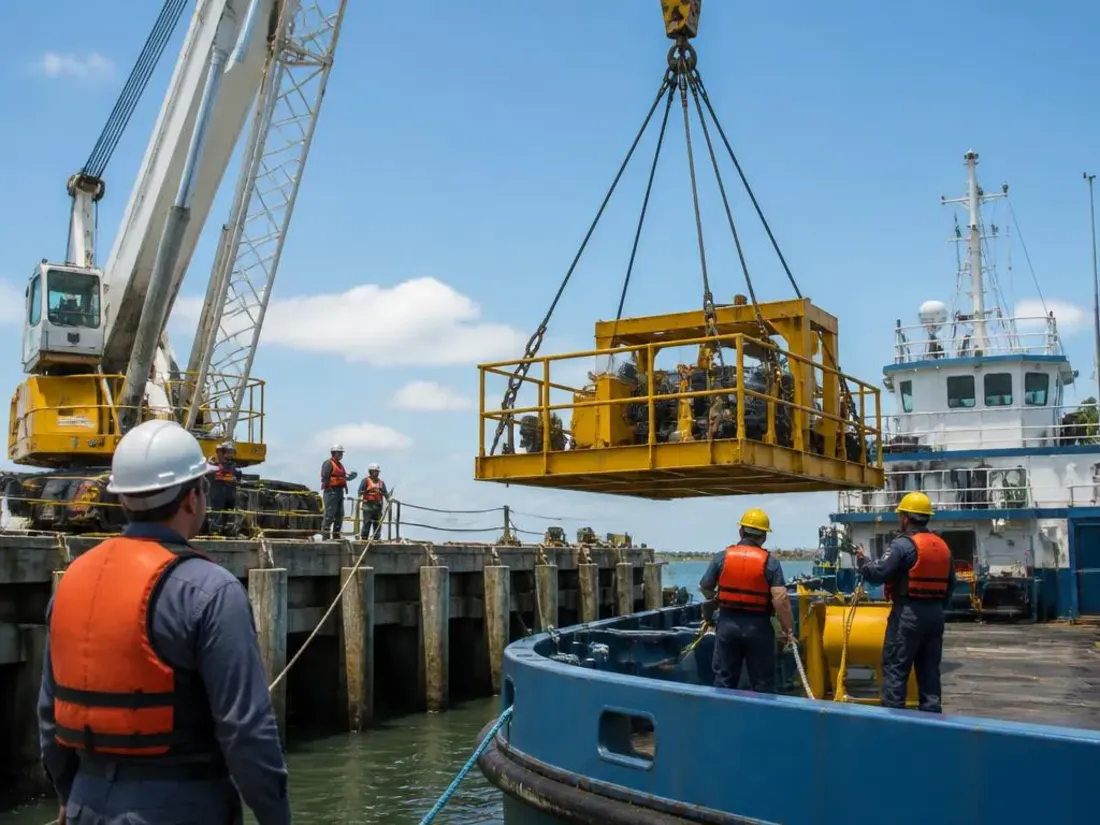
Third-Party Maritime Injury Lawyer in New Orleans: Looking Beyond Your Employer
The Young Firm is a New Orleans maritime injury law firm that represents injured seamen, offshore workers, and harbor workers across Louisiana and the Gulf Coast. This page is about one specific question: whether someone besides your employer is legally responsible for what happened to you, and what it takes to find out.
You do not need to know the right defendant, the right statute, or the right label for your claim before asking for a review. Sorting out who owned the vessel, who directed the task, who supplied the equipment, and who was supposed to maintain it is part of the work. Contact The Young Firm to request a third-party claim review. Bring what you know; incomplete company information is expected at the start.
Can I Sue Another Company for an Offshore or Maritime Injury?
Potentially, yes. But being injured at work, or on another company's vessel or property, does not by itself create a lawsuit against that company. A third-party maritime claim requires a cause of action the law actually gives you against that company, proof that the company's conduct or product caused your injury, and the absence of a defense or immunity that shields it. For a negligence claim, that means the company owed you a legally recognized duty, breached it, and the breach caused your injury. For a product claim, it means the equipment was defective. Which claims exist, and which law defines them, depends on your work status, where the accident happened, whether a vessel was involved, and what role the company played.
In plain terms, a "third party" is a company other than your employer that may be legally responsible for your injury. That definition has a trap in it. Your employer for legal purposes is not always the company on your paycheck. Under what courts call the borrowed-employer doctrine, a company that borrows your labor and controls your day-to-day work can be treated as your employer. If it is, the consequences depend on which framework governs your employment, and the two main frameworks point in opposite directions. Under a compensation statute such as the Longshore Act, a borrowing employer may receive the same immunity from ordinary negligence suits that your payroll employer has, which would take it out of the third-party category. Under the Jones Act, a qualifying seaman may sue his or her employer for negligence, so a company found to be your Jones Act employer may be a proper defendant for employer negligence rather than a shielded outsider. Either way, the label changes the claim. A different company name on the side of the boat does not settle the question, and neither does control alone. The arrangement between the companies, the direction of your work, and the governing statute all have to be examined.
It also helps to keep three different kinds of claims separate:
- Jones Act negligence is a claim by a qualifying seaman against his or her employer under 46 U.S.C. § 30104. It is an employer remedy, not a claim against outsiders. If your question is about the company you work for, start with Jones Act claims against your employer.
- Third-party negligence is a claim against a non-employer under general maritime law or, in some settings, state law. The vessel owner, a contractor, a terminal operator, or a charterer can be a third party if the facts support it.
- Product liability is a claim against the manufacturer or seller of defective equipment. It turns on the product's design, manufacture, or warnings rather than on anyone's on-site negligence.
For workers covered by the Longshore and Harbor Workers' Compensation Act, 33 U.S.C. § 905(a) makes the employer's compensation liability exclusive, while § 905(b) preserves a negligence claim against the vessel and § 933 addresses claims against other third parties. Those rights are real, but they carry conditions, including restrictions tied to your specific job and settlement rules that can affect your benefits. The short answer, then, is: a third-party claim may be available, it does not replace your employer remedy, and it needs to be evaluated on facts rather than assumed. How these claims fit together with Jones Act and Longshore rights is covered in detail on third-party claims alongside Jones Act or LHWCA remedies.
Who Paid You, Owned the Vessel, Controlled the Work, and Supplied the Equipment?
On a Mississippi River fleeting operation, a Port Fourchon dock, or a jack-up rig in the Gulf, it is common for four or five companies to have a hand in a single task. The first job in any third-party investigation is to separate the roles. The same company can hold more than one; more often, they are split.
| Role | Fact to establish | Potentially relevant claim category | Key qualification |
|---|---|---|---|
| Payroll employer | Who hired you, paid you, and could fire you | Jones Act (seamen) or LHWCA / other compensation (non-seamen) | Employer negligence claims are governed by employer-specific statutes, not general third-party law |
| Possible borrowed employer | Who actually directed your work day to day, and under what agreement with your payroll employer | May be treated as an employer; under a compensation statute that can mean immunity, while under the Jones Act it can make the company the proper employer-negligence defendant | Control over the details of the work matters more than the name on the check, but control alone does not decide status or immunity |
| Vessel owner | Who holds title to the vessel | General maritime negligence; § 905(b) vessel negligence for covered longshore workers; unseaworthiness for seamen | Ownership alone does not establish liability; negligence requires breach of a duty the owner owed you, while a seaman's unseaworthiness claim turns on the vessel's condition rather than on fault |
| Vessel operator or charterer | Who was running the vessel and crewing it under a charter or management agreement | Negligence based on operational control | Charter terms often decide which company had responsibility for the condition or the operation |
| Contractor or subcontractor | Who was performing the task, or the adjacent task, that caused the injury | Negligence | The contractor must have owed you a duty; contract terms and actual conduct both matter |
| Premises or facility operator | Who controlled the dock, terminal, platform, or yard | Premises negligence | Whether maritime or state law governs depends on the location and the nature of the activity |
| Equipment manufacturer or seller | Who designed, built, or sold the equipment that failed | Product liability | Requires proof of a defect, not merely that the equipment failed during use |
| Maintenance or inspection provider | Who serviced, inspected, or certified the equipment | Negligence | Records and service history usually determine whether the provider had a role in the failure |
Can I sue the vessel owner? Possibly. It depends on your status, the duty the owner owed you, what the owner did or failed to do, and statutory limits that apply to certain workers. For a seaman, a general maritime negligence claim against a non-employer vessel owner is one possible route. A seaman's unseaworthiness claim is different in kind: it is a vessel-condition obligation rather than a negligence claim, and it generally lies against the vessel owner or other party bearing the seaworthiness obligation, which may also be your employer. That claim is explained on unseaworthiness claims. For a longshore or harbor worker covered by the LHWCA, the route is the § 905(b) vessel negligence action, and under Scindia Steam Navigation Co. v. De Los Santos and Howlett v. Birkdale Shipping Co. the vessel's duties are defined and limited rather than open-ended. Section 905(b) also restricts the vessel claim in certain situations tied to the worker's employment. None of that means the owner is off the hook; it means the analysis has to be done. The general framework is explained on claims against a vessel owner, and the longshore-specific duties on Section 905(b) vessel negligence claims.
When the question is about a company on the dock, the platform, or the work crew rather than the vessel itself, see contractor and premises negligence. When the question is about a piece of equipment that failed, see defective maritime equipment claims.
These examples are meant to show how roles split across companies. They are not descriptions of any particular case.
Your Work Status and Accident Location Can Change the Legal Route
Two workers hurt in the same accident can end up with different claims. That is not a quirk; it follows from how maritime law assigns remedies by status and location. Working offshore, or living in Louisiana, does not by itself tell you which law governs your third-party claim.
| Your likely status | Remedies tied to your status | Third-party route to examine | Unresolved questions that decide it |
|---|---|---|---|
| Seaman (member of a vessel's crew) | Jones Act negligence and maintenance and cure against your employer; unseaworthiness against the vessel owner, who may or may not be your employer | General maritime negligence against non-employer vessel owners, contractors, and others; product liability against manufacturers | Do you actually meet the seaman test? Was the defendant your borrowed employer? Which company owned versus operated the vessel? |
| LHWCA-covered longshore or harbor worker | LHWCA compensation benefits from your employer | § 905(b) vessel negligence; § 933 claims against other third parties | Does a § 905(b) job-based restriction apply? Which vessel duty is in play? Are you receiving benefits under a formal award? |
| Offshore or shoreside worker needing further classification | Depends on classification | Depends on classification and location | Was a vessel involved? Were you on a fixed platform on the Outer Continental Shelf? Does state law apply through OCSLA? |
A few points behind this table:
Seaman status is a threshold question. The Jones Act protects members of a vessel's crew whose connection to a vessel or fleet is substantial in both duration and nature. Whether you qualify affects your employer remedy and can affect how your third-party claim is analyzed. Status is a fact-intensive question, covered on Jones Act seaman status.
LHWCA coverage is a different threshold. Longshore, shipyard, and harbor workers generally cannot sue their employer for negligence at all; their recourse is compensation plus the third-party routes above. Coverage and benefits are addressed on Longshore Act benefits and claims.
Compensation coverage and governing tort law are separate. The Outer Continental Shelf Lands Act, 43 U.S.C. § 1333, extends LHWCA compensation to certain workers injured on the shelf. It can also adopt the adjacent state's law as surrogate federal law, but only under conditions: the dispute must arise on a covered OCSLA situs, such as a fixed platform or similar structure; maritime law must not apply of its own force; and the state rule must fill a gap federal law leaves open without being inconsistent with federal law. When those conditions are met, a worker hurt on a fixed platform off Louisiana may have a state-law negligence claim against a contractor even though the setting looks "maritime." A worker hurt on a vessel in the same waters may have a general maritime law claim instead. Whether a structure is a vessel, whether the injury has a sufficient maritime connection, and whether state law is actually filling a gap are questions a lawyer has to work through with your facts.
Unseaworthiness is a vessel-condition remedy. It runs against the vessel owner or operator and is available to seamen, not longshore workers. It is a distinct claim, covered on unseaworthiness claims, and it should not be confused with third-party negligence.
One more caution. The Jones Act uses a relaxed causation standard that favors injured seamen. That standard belongs to the Jones Act claim against your employer. A third-party negligence claim is generally judged by ordinary negligence rules, which means the proof has to be more complete. If your situation involves offshore work and you are not yet sure how any of this applies, the broader starting point is offshore injury claims.
An Injury Report May Not Tell You Which Company Was Responsible
An employer's incident report may document the event without fully identifying every company's role, what the contracts assigned to whom, or how each company's conduct or equipment contributed to the injury. Whoever prepared it may not have had the charter, the service agreements, or the maintenance history in front of them. That is why answering the responsibility question usually takes records beyond the report itself.
A negligence investigation has to connect three things with evidence: a duty a company legally owed you, a breach of that duty, and the injury. Company presence at the site, ownership of the equipment, or a logo on a hard hat are starting points. None of them is proof.
The records that tend to answer the responsibility question include:
- Contracts and master service agreements, which often assign responsibility for equipment, safety, and supervision between the companies.
- Charter parties and vessel management agreements, which decide whether the owner or a charterer controlled the vessel's operation and crew.
- Work orders, job safety analyses, and lift plans, which show who planned the task, who approved it, and what conditions were expected.
- Maintenance and inspection logs, which show whether equipment was serviced, by whom, and whether known problems were left uncorrected.
- Radio logs, emails, and text messages, which often reveal who made the decision to proceed and what they knew at the time.
- Witness accounts, particularly from workers employed by other companies, whose view of the event may differ from the report's.
Hypothetical example. A deckhand is struck by a load during a crane transfer from a supply vessel to a platform. The deckhand works for a crewing company. The vessel is owned by one company and chartered to an energy company. The crane is owned by the platform operator, was operated by a contractor's rigger, and was serviced three weeks earlier by a third-party inspection firm. This single event raises at least three separate investigations: whether the operation was negligently planned or carried out (the contractor, the charterer, possibly the vessel operator); whether the crane was negligently maintained or inspected (the platform operator and the service firm); and whether a component failed because of a design or manufacturing defect (the manufacturer). Each theory requires different evidence and a different legal analysis. None of the companies is liable simply because it was there, and none is cleared simply because the incident report does not mention it.
Negligence and product-defect theories are not interchangeable. A negligence claim asks whether a company acted unreasonably. A product claim asks whether the equipment itself was defective when it left the manufacturer, regardless of how carefully anyone on site behaved. Sometimes both are worth pursuing; sometimes the records point clearly to one. The contractor and premises side is developed on contractor and premises negligence; the equipment side on defective maritime equipment claims.
Shared fault also needs careful handling. If you made a mistake, or your employer did, that does not by itself excuse another company whose negligence contributed to the accident. What shared fault does to your recovery depends on which law governs the claim and on how fault is allocated among the parties. Do not assume a claim is worthless because you were partly at fault, and do not assume your employer's fault is someone else's problem to sort out.
Receiving Benefits and Settling a Third-Party Claim Are Different Decisions
Workers often hold back from asking about a third-party claim because they are afraid of losing the benefits they depend on. The fear is understandable, but the two things are not the same decision.
Accepting ongoing benefits — maintenance and cure if you are a seaman, LHWCA compensation and medical benefits if you are a longshore or harbor worker — does not by itself bar you from pursuing a company other than your employer. For LHWCA-covered workers, 33 U.S.C. § 933 specifically contemplates that you can receive compensation and also pursue a responsible third party.
Settling a third-party claim is where the risk lies. Section 933 imposes approval and notice requirements on third-party settlements, and a settlement that does not satisfy them can put future compensation and medical benefits at risk. A third-party recovery can also give the employer or its insurer a credit or lien, and the timing of a lawsuit after a formal compensation award can affect who controls the third-party claim. Which of these consequences applies depends on your coverage, the terms of any award, and how the recovery is structured.
For seamen, the interaction is different. Maintenance and cure is owed regardless of fault, and a third-party recovery can raise reimbursement or credit questions rather than forfeiture, but a release drafted broadly enough can still extinguish rights you did not intend to give up.
Before you sign anything: a release, a settlement agreement, a "receipt" from an insurer, or any document that resolves a claim against any company, have a lawyer read it first. Releases are frequently written to cover every company and every claim, not just the one you think you are settling. Once signed, they are hard to undo.
This section is a warning, not the full set of rules. It is not a promise that every lawsuit leaves your benefits untouched, and it does not mean you can be paid twice for the same loss. The detailed coordination of employer claims, benefits, credits, and settlement approvals is on third-party claims alongside Jones Act or LHWCA remedies. Benefits administration for seamen is on maintenance and cure benefits, and for longshore workers on Longshore Act benefits and claims.
Potential Damages Are Not the Same as the Amount You Take Home
Depending on the claim and the governing law, a third-party maritime injury claim may seek:
- Past and future medical expenses, proven through medical records, bills, and treating-physician opinions about future care.
- Lost earnings, proven through pay records, tax returns, and work history, including offshore schedules and overtime patterns.
- Reduced earning capacity, which usually requires medical restrictions plus vocational and economic analysis of what you can and cannot do going forward.
- Pain, suffering, and loss of enjoyment of life, supported by medical documentation and the testimony of people who know how the injury has changed your daily life.
Three different tasks sit underneath any recovery, and workers tend to collapse them into one number:
- Proving your losses. This is the documentation problem: showing what the injury cost you and will cost you.
- Establishing liability. This is the responsibility problem: showing that a particular company breached a duty and caused the injury. A perfectly documented loss recovers nothing from a company that did not owe you a duty.
- Understanding what reaches you. This is the arithmetic that happens after the first two, and it involves three distinct effects that should not be lumped together. Fault allocated to you can reduce the damages you are legally entitled to recover, depending on the governing law. Attorney fees, case costs, and medical or compensation liens are paid out of the proceeds, according to your fee agreement and the liens that actually attach. And a compensation carrier or maintenance-and-cure payor may be entitled to a credit against future benefits, which affects what you receive going forward rather than the settlement check itself. Which of these applies, and in what amount, depends on the law governing your claim and how the recovery is arranged. The details are on how third-party recoveries affect benefits and reimbursement.
Adding more defendants does not automatically increase what you recover. It can, when more than one company shares responsibility and each has the means to pay. It can also complicate the case, spread fault, and lengthen the timeline. Whether punitive damages are available depends on the claim and the governing law, and they should not be assumed.
If the injury was fatal, the categories of loss and the family members who can recover are different and are addressed on maritime wrongful death claims.
Preserve the Facts That Can Identify the Responsible Companies
Get medical care first. Report the incident to your employer accurately and promptly. Then, without delaying treatment or taking anything you are not entitled to, preserve what you can. Here is what helps and why.
| What to preserve | Why it matters |
|---|---|
| Pay stubs, W-2s, dispatch records, crew lists | Establish who your payroll employer was and how the working arrangement was structured |
| Photographs and video of the scene, the equipment, and your injuries | Document conditions before they change and capture equipment identifiers: serial numbers, rental tags, company names on the gear |
| Names and contact details of witnesses, especially workers from other companies | Other companies' employees often know who owned, operated, or serviced what |
| Your own written account | Record the date, precise location, vessel or facility name, the task you were doing, who supervised it, and every company you know was involved, while the details are fresh |
| Text messages, emails, radio notes, and photos already on your phone | Show who made decisions and what was known; keep originals and do not delete or edit anything relevant |
| Medical records and discharge papers | Document the injury, the mechanism, and the treatment timeline |
| Signed documents, insurer letters, benefit statements, and any court notices | Identify what rights may already be affected and what deadlines may already be running |
A few limits. Preserve only what you can lawfully access. Do not remove equipment, go back onto a vessel or facility you no longer have permission to enter, or log into systems you are not authorized to use. Counsel can request contracts, surveillance footage, vessel logs, and formal preservation of equipment through proper channels once retained. Your job is to keep what you have, not to build the case yourself.
Do Not Assume Every Third-Party Maritime Claim Has the Same Deadline
Many maritime personal injury claims are governed by 46 U.S.C. § 30106, which sets a general three-year period from the date the cause of action arose. That number is widely repeated as "the offshore deadline." It is not universal, and relying on it without checking can be a costly mistake. Several things can shorten the time available or require earlier action:
- State law may govern. If your claim against a contractor or platform operator is a state-law claim, including a state-law claim applied through OCSLA, the state's own limitation period controls. State deadlines can be shorter than three years and can depend on the date of injury. No Louisiana period is stated here because it must be confirmed against current law and the effective-date rules for your accident date.
- Government defendants have their own procedures. Claims involving government-owned vessels or federal agencies are subject to separate statutes with different, often shorter, time limits and pre-suit requirements.
- Limitation-of-liability proceedings. A vessel owner facing claims can file a limitation action in federal court. When that happens, the court sets a deadline for all claimants to file, and a notice you receive in the mail may carry a date that arrives well before any three-year mark.
- Accrual is not always the accident date. For some injuries the clock starts when you knew or should have known of the injury and its cause. That question is fact-specific.
Keep four sets of deadlines separate: the incident-reporting requirements your employer imposes; the filing deadlines that govern compensation benefits (for longshore workers, see LHWCA filing deadlines); the limitation period for a negligence lawsuit against your employer (for seamen, see Jones Act deadlines); and the limitation period for a lawsuit against a third party. Meeting one does not satisfy the others.
If you have received a court notice, been handed a proposed release, or know that a date is approaching, get it reviewed now. A consultation does not by itself stop any clock.
What a Third-Party Claim Review Needs to Cover
An initial review is a structured conversation, not a completed investigation. Its purpose is to figure out whether a claim against a non-employer is worth pursuing and what has to happen first. To do that, it has to cover the following ground.
Your role and status. What you did, for whom, on what vessel or facility, and for how long. This drives the seaman-versus-longshore question and frames everything else.
The incident and the companies involved. What happened, where, and every company you know had a role: your employer, the vessel owner, any contractor, the facility operator, equipment suppliers. Gaps are expected. Identifying the rest is investigative work.
Existing benefits and claims. What you are receiving, from whom, under what arrangement, and whether any claim has already been filed, settled, or denied.
Urgent documents. Any release, settlement paper, insurer correspondence, or court notice you have received, reviewed for deadlines and for rights that may be at risk.
The next investigative questions. Which records need to be requested, which companies need to be identified, and which legal questions — borrowed employer, vessel duty, governing law — need answers before responsibility can be assessed.
The result should be a preliminary picture of your status, the parties who may be responsible, the deadlines in play, and the benefits issues to protect. It is not a guarantee of a lawsuit, a recovery, or representation. Before you agree to representation with any firm, ask about consultation and fee terms and confirm when representation begins.
The Young Firm's work centers on New Orleans and the Louisiana Gulf Coast: river and harbor work on the Mississippi, port and terminal operations, and offshore operations supported from Louisiana. That regional footing is useful because the multi-company arrangements described on this page are common here. It does not mean Louisiana law governs every Gulf injury; as explained above, the governing law follows the facts. For the firm's broader background and the full range of matters it handles, see the homepage.
Legal Sources for This Third-Party Claims Guide
This guide provides general information about third-party maritime injury claims. It is not a determination of any individual worker's rights, and it should not be relied on in place of advice about your specific facts.
The legal explanations above draw on the following primary authorities:
- 46 U.S.C. § 30104 (Jones Act) — the seaman's negligence remedy against an employer, referenced to distinguish employer claims from third-party claims.
- 46 U.S.C. § 30106 — the general three-year limitation for maritime personal injury and death actions, subject to exceptions and applicability analysis.
- 33 U.S.C. § 905 — LHWCA employer exclusivity under subsection (a) and the vessel negligence action, its job-based restrictions, and the exclusion of unseaworthiness under subsection (b).
- 33 U.S.C. § 933 — compensation and third-party recovery, including approval, notification, assignment, credit, and reimbursement provisions.
- 43 U.S.C. § 1333 (Outer Continental Shelf Lands Act) — extension of LHWCA coverage and application of adjacent-state law to certain Outer Continental Shelf structures.
- ***Scindia Steam Navigation Co. v. De Los Santos*, 451 U.S. 156 (1981) and *Howlett v. Birkdale Shipping Co.*, 512 U.S. 92 (1994)** — the framework of vessel duties owed to longshore workers, referenced here only at overview depth. The framework is addressed on Section 905(b) vessel negligence claims.
The hypothetical lifting incident in this guide is illustrative and is not drawn from any client matter. No case results are described on this page.
Statutes are amended and courts refine doctrine. Nothing on this page substitutes for advice applying current law, including controlling Fifth Circuit decisions, to your facts.
Ask The Young Firm to Review the Companies Involved in Your Injury
You do not need to have this figured out. If you were hurt on a vessel, a dock, a terminal, a platform, or a rig, and you have any reason to think a company other than your employer had a hand in it, that is enough to ask.
When you contact the firm, be ready to share what you know:
- What happened, and the date and location, including the vessel or facility name.
- Your job duties and how long you had been doing them.
- Who employed you, and any other companies you know were on site or involved.
- Any benefits you are receiving and who is paying them.
- Any documents you have signed, letters from insurers, or notices from a court.
If you are missing some of this, say so. Incomplete information is normal at the start; identifying the companies and the records is part of what a review is for. Do not send medical records or other sensitive documents until the firm tells you how it wants to receive them.
A review is not a promise of a lawsuit, a recovery, or representation, and it does not by itself preserve a deadline or guarantee that your benefits or your job will be unaffected. It is the step that determines which companies are worth investigating, which documents need attention now, and what your realistic next step is.
Contact The Young Firm in New Orleans to request a third-party claim review.