
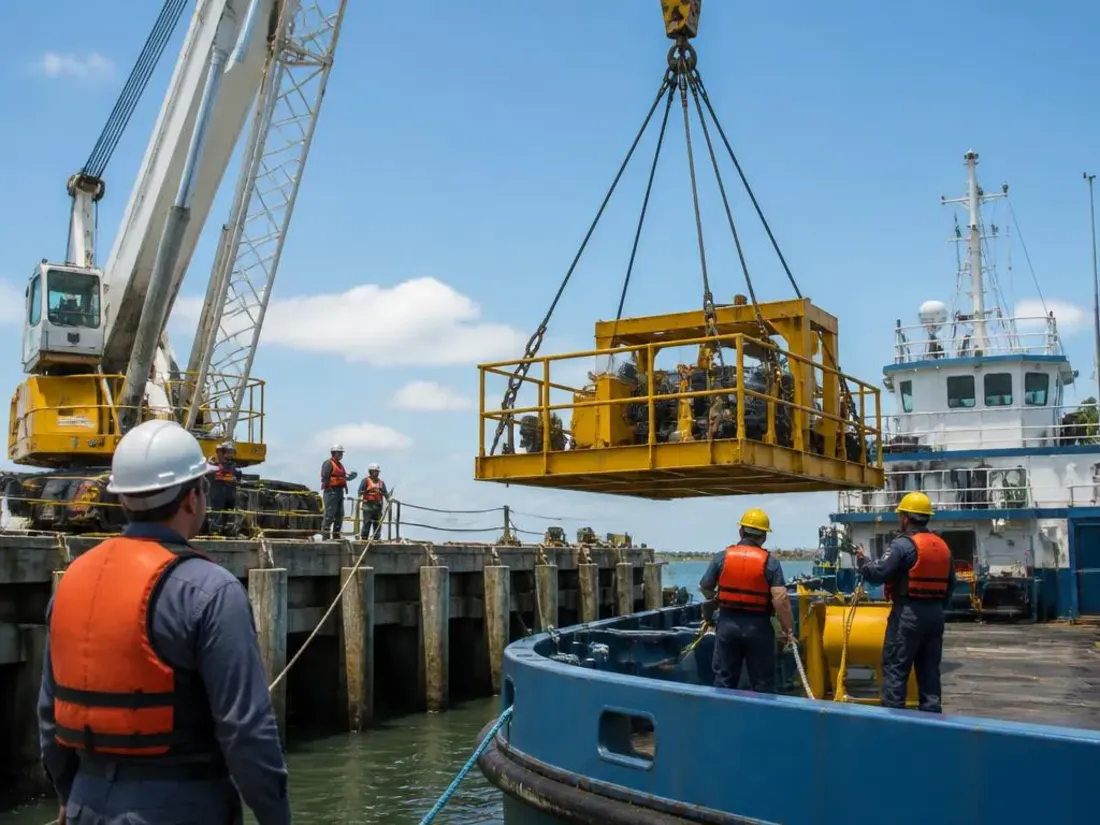
A "third party," in this context, is a person or company other than your legally protected employer: a vessel owner that is not your employer, a separate contractor on the same job, a platform or dock owner, an equipment manufacturer, a charterer. The word "separate" carries real weight. Which company is actually your employer for legal purposes is a question that often requires investigation, not something you can read off a hard hat or a paycheck.
Whether an additional claim exists, and what it does to the payments you already receive, depends on four things: your employment status, the relationships among the companies on the job, the law that governs the accident, and the settlement rules that attach to your underlying claim. A seaman with a Jones Act claim and a longshore worker receiving LHWCA compensation are on two different routes. The routes are not interchangeable, and the entitlements do not simply stack.
This page explains how those routes work when a third party may be involved. It does not replace the broader discussion of third-party maritime injury claims, which covers who can be held responsible in the first place. Here, the focus is narrower: you already have a claim or benefits, and you want to know what else may be available and what could go wrong. Multi-company job sites are common in Gulf Coast maritime work — supply boats out of Port Fourchon, Mississippi River operations, New Orleans-area shipyards and terminals — but location is context, not an answer. The governing law follows the facts of the work, not the state on your driver's license.
If another company may have had a hand in your injury, or someone has put a release in front of you, The Young Firm can review the claim or benefits you already have alongside any additional claim. You do not need to know which legal category applies before asking.
Can I Bring a Third-Party Claim in Addition to a Jones Act Claim?
A qualifying seaman may pursue a Jones Act negligence claim against the employer under 46 U.S.C. § 30104 and, separately, a claim against a non-employer whose negligence contributed to the injury. The third-party claim must stand on its own legal basis under general maritime law or applicable state law; it is not a second Jones Act claim. Both claims may address the same injury, but the law does not permit payment twice for the same loss.
The Jones Act is an employer statute. It gives a seaman the right to sue his or her employer for negligence, and the full explanation of how that claim works belongs on our page about Jones Act claims against your employer. What it does not do is create a claim against everyone else on the job. If a separate company's conduct hurt you, the claim against that company comes from general maritime law or, in some settings, state law — with its own standards for duty, breach, and causation.
That matters in practice because each defendant has to be evaluated on its own conduct. Your employer's negligence is one question. Whether a different company owed you a duty, what that duty required, whether the company breached it, and whether that breach caused your injury are all separate questions. A review limited to the employer claim can leave those questions unasked.
Consider a hypothetical. A deckhand employed by a vessel operator is working on the back deck of an offshore supply vessel alongside a platform. A crane operated by a separate contractor's crew drops a load without warning, and the deckhand is struck. The deckhand may have a Jones Act claim against the vessel operator if the operator's own negligence contributed — inadequate crew, poor communication procedures, a failure to stop unsafe work. The deckhand may also have a separate negligence claim against the crane contractor. But that second claim exists only if the crane contractor is genuinely a third party (not, for example, a company that has legally borrowed the deckhand as its own employee) and only if its negligence can be proven under the law that applies to the accident.
Two other seaman remedies deserve a brief mention so they are not confused with the third-party claim. Maintenance and cure is the employer's obligation to pay living expenses and medical costs while an injured seaman recovers, and it does not depend on anyone's fault. Unseaworthiness is a claim against the vessel owner for an unfit vessel, crew, or equipment. Both are distinct from a negligence claim against an outside contractor, and both have their own eligibility and damages rules that those pages cover.
Having three or four possible claims does not mean three or four separate recoveries for the same medical bill or the same lost paycheck. Multiple claims widen the field of responsible parties. They do not multiply the loss.
Can I Receive LHWCA Benefits and Sue a Third Party?
Under 33 U.S.C. § 933, a worker receiving Longshore compensation generally does not have to choose between benefits and a lawsuit against a legally responsible third party; the two can proceed together. That coordination comes with conditions — assignment rules, settlement approval and notification requirements, reimbursement to the employer or carrier, and credits against future compensation. A third-party recovery can change what the employer or carrier owes you going forward, so continued benefits at the same level should never be assumed.
The Longshore and Harbor Workers' Compensation Act is a compensation system, and 33 U.S.C. § 905(a) makes the employer's liability under that system exclusive. As a general rule, you do not sue your Longshore employer for negligence; you receive compensation and medical benefits instead. The statute contains narrow exceptions — for example, where an employer fails to secure the compensation it is required to provide — and whether any exception applies requires case-specific review. Our overview of Longshore Act benefits and claims explains what the benefits are and how they are calculated.
Employer exclusivity shields the employer. It does not, by itself, extend to a vessel owner, a separate contractor, a terminal operator, or an equipment manufacturer that is genuinely independent of your employer. Two cautions apply, though. A company with a different name on its trucks is not automatically suable; if that company legally qualifies as your employer, including as a borrowing employer, the same exclusivity may protect it. And the Act extends certain protections beyond the employer itself — for instance, to coworkers acting within the scope of their employment. Company names are the start of the analysis, not the end.
Section 905(b) creates a specific route against a vessel. A covered worker injured by the negligence of a vessel may bring an action against the vessel owner. Several limits are built into that route. It is a negligence claim only — the statute expressly removes unseaworthiness as a basis for a covered worker's recovery against the vessel. It is not triggered simply because an injury happened aboard a ship; the vessel must have breached a duty it actually owed under the case law that defines those duties. And the statute imposes further restrictions in specific relationships — for example, where the worker was employed by the vessel itself to provide stevedoring services, or was performing shipbuilding, repair, or breaking work for an employer that owned, operated, or chartered the vessel. Those restrictions turn on the employment and vessel relationships involved, not on a job title alone. Our page on Section 905(b) vessel-negligence claims covers what a vessel owes to longshore workers and how those restrictions operate.
Here is a hypothetical to make the distinction concrete. A longshore worker employed by a stevedoring company is discharging cargo from a ship owned by an unrelated foreign shipping line. During the operation, a defective hatch cover mechanism that the ship's crew knew about, and did not disclose, fails and injures the worker. The worker receives LHWCA compensation from the stevedore's carrier. The worker may also have a Section 905(b) claim against the shipowner — if the facts show the vessel breached one of its recognized duties, and if none of the statutory restrictions applies. Whether the hatch cover defect gives rise to vessel liability depends on the vessel-duty analysis explained on our Section 905(b) page, not on the mere fact that the accident happened on board.
The practical caution belongs right here rather than in a footnote. Pursuing the shipowner is not a side project separate from the compensation claim. Any settlement or judgment against the shipowner feeds back into the Longshore claim through reimbursement and credit rules, and a settlement handled without the required approval or notice can end compensation and medical benefits entirely. Those rules are discussed below, but the takeaway is simple: the two proceedings have to be managed together.
Benefit Checks and Company Names Do Not Settle Every Coverage Question
Workers often disqualify themselves before anyone has looked at the facts. Two assumptions do most of the damage: "I've been getting Longshore checks, so I can't be a seaman," and "I was supervised by another company, so I can sue them."
Payments, awards, and releases are not the same thing. Receiving voluntary compensation payments from an employer's carrier is different from accepting compensation under a formal award entered in a compensation order, which is different again from signing a settlement or release. Each has different legal consequences for your other claims. Voluntary payments, on their own, resolve very little. A formal compensation order can trigger consequences discussed in the deadline section below. A signed release can extinguish claims outright, depending on its language. Before anyone classifies your claims, the documents behind the payments need to be read.
Longshore benefits do not, by themselves, decide seaman status. The Supreme Court in Southwest Marine, Inc. v. Gizoni recognized that a worker who has received LHWCA benefits may still pursue a Jones Act claim if he or she in fact qualifies as a seaman; the LHWCA definition of "employee" in 33 U.S.C. § 902 excludes a master or member of a crew of a vessel, and whether you fall inside or outside that exclusion is a factual question. The two coverage systems are meant to be mutually exclusive, not cumulative — you are ultimately one or the other. Section 903(e) credits specified payments, including amounts paid under the Jones Act for the same injury, against any LHWCA liability. How Longshore payments already received are treated in a later Jones Act recovery is a separate question, governed by the applicable authority and by the circumstances of the payments — including whether they were voluntary or made under an award. But the fact that a carrier began paying Longshore benefits does not prove the carrier was right about your status. Whether you qualify as a Jones Act seaman is a separate analysis, covered on our page about whether you qualify as a Jones Act seaman, and the full Longshore coverage discussion sits with Longshore Act benefits and claims. The consequences of a formal award, as opposed to voluntary payments, are among the distinctions that page and a lawyer's review need to address.
A company that is not your payroll employer may still be your employer in law. Under the borrowed-employee doctrine applied by the federal courts, a company that controls your work can be treated as your employer — with employer immunity — even though a different company signs your checks. Courts look at a cluster of facts rather than any single test: who directed the details of your work, whose work you were doing, what the contracts between the companies said, whether your payroll employer had effectively stepped aside, who furnished tools and the workplace, how long the arrangement lasted, who could end it, and who paid you. Payroll records, contracts, work orders, dispatch records, and supervision evidence are the raw material for that analysis. A worker cannot be expected to sort this out alone, and a company's name on a purchase order does not settle it.
Different defendants raise different questions. If the possible third party is a vessel owner, the relevant analysis is on our page about vessel-owner negligence claims. If it is another contractor, a platform or dock owner, or a charterer, see claims involving another contractor or premises owner. If a piece of equipment failed, see maritime product and equipment liability. This page does not repeat those liability elements; it explains how any such claim fits alongside what you already have.
Offshore location can change the governing law. The Outer Continental Shelf Lands Act, 43 U.S.C. § 1333, extends federal law — and, in some circumstances, adopts adjacent state law as surrogate federal law — to certain structures and operations on the shelf. Whether you were on a vessel or a fixed platform, what operation was underway, and where the accident happened can determine whether general maritime law, Louisiana law, or another state's law governs your third-party claim, and that in turn affects the available remedies and deadlines. Living in Louisiana does not decide the question.
An Additional Claim Does Not Mean Payment Twice for the Same Loss
A third-party claim does not add a second full recovery on top of the first. What it can do is reach losses the underlying claim or benefit system does not fully compensate, and shift responsibility to a company that actually caused the harm. Overlapping payments are then coordinated, and how they are coordinated differs by route.
| Jones Act route | LHWCA route | |
|---|---|---|
| Underlying remedy | Negligence claim against the employer under 46 U.S.C. § 30104, plus maintenance and cure; possibly unseaworthiness against the vessel owner | Compensation and medical benefits from the employer or carrier; employer liability exclusive under § 905(a), subject to narrow statutory exceptions |
| Basis for the additional claim | General maritime law or applicable state law negligence against a genuine non-employer | Section 905(b) vessel negligence, or general maritime/state law negligence against a genuine non-employer, via § 933 |
| Treatment of overlapping loss | No double recovery for the same element of damage; credit and offset issues (including maintenance and cure already paid) analyzed under maritime case law specific to the claims involved | Repayment of compensation and medical benefits already paid, under the employer's and carrier's lien recognized in case law; credit against future compensation measured by the statutory net recovery under § 933(f); carrier rights under § 933(h) |
| Principal settlement concern | Scope of any release and its effect on other defendants and remedies | § 933(g) approval and notification requirements; effect on future compensation and medical benefits; scope of release |
On the LHWCA route, four figures have to be kept apart, because they are easy to run together.
The gross recovery. The settlement or judgment amount. This is the number the defendant's insurer will quote, and it is not the number that matters to you.
The statutory net recovery. Section 933(f) measures the employer's future obligation against the worker's "net" recovery, which the statute defines as the amount actually recovered less the reasonable expenses of the third-party proceeding, including attorney's fees. This is a defined statutory figure, not your take-home amount.
Repayment of benefits already paid (the lien). Separately, the employer and carrier are generally entitled to be repaid, out of the recovery, the compensation and medical benefits they have already provided. That right comes from case law recognizing the employer's lien, and how litigation costs are shared between the worker and the lienholder is itself governed by case law. This is a claim against money you have already won.
Credit against future benefits. Under § 933(f), the employer remains liable for future compensation only to the extent it exceeds the statutory net recovery. This affects money you have not yet received. After a third-party recovery, the carrier may pay less, or nothing, for a period of time, and medical benefits are not automatically insulated from these rules.
How these figures interact in a given case — what is repaid, what is credited, and how fees and expenses are allocated among them — depends on the amounts paid, the terms of the settlement, and the authority applied to the allocation. There is no universal formula, and a proposed "net to you" figure should be checked against each of these components before you rely on it.
Section 933 governs LHWCA interests; it does not govern a seaman's Jones Act claim as such. Coordination between a Jones Act recovery, maintenance and cure already paid, and a third-party recovery is governed by maritime case law, and the analysis is specific to which defendants paid what for which losses. But if your status is disputed, or a Longshore carrier has already paid you benefits, those Longshore interests still have to be reviewed before any settlement, whichever route you believe you are on. Our page on Jones Act compensation and damages covers the damage categories themselves; Longshore benefit calculations belong to the Longshore Act benefits and claims page.
Before a Third-Party Settlement: Check Approval, Notice, and Release Terms
For a worker receiving LHWCA benefits, 33 U.S.C. § 933(g) can terminate all rights to compensation and medical benefits if a third-party settlement is entered without the required written approval or without notifying the employer. Approval and notification are separate obligations. Get the settlement reviewed against the statute, and against the release language, before signing.
The statute's structure, in plain language:
When written approval is required. If a covered worker settles with a third party for an amount less than the compensation the worker would be entitled to under the Act, the employer remains liable for compensation only if written approval of the settlement is obtained from the employer and the employer's carrier before the settlement is executed, with the worker's participation. The statute also prescribes the form of that approval and a short window for filing it with the Department of Labor. The threshold comparison between the settlement amount and the compensation entitlement is itself a calculation that must be done carefully; a settlement that looks large may still fall below the statutory line once future compensation is valued. Each of these requirements — who signs, in what form, filed where and by when — must be confirmed against the current statute and the office handling your claim before the settlement is signed.
Notification is required regardless. Even where the settlement exceeds the approval threshold, the worker must notify the employer of any settlement or judgment obtained against a third party. Notification is not a substitute for approval, and approval does not excuse notification. They are independent requirements.
What noncompliance costs. If required approval is not obtained, or if the employer is not notified, the statute provides that rights to compensation and medical benefits terminate — and the statute is explicit that this applies regardless of whether the employer has made payments or acknowledged entitlement. That is the forfeiture workers fear, and it is real. The timing of the two obligations differs, though. Where written approval is required, the statute calls for it before the settlement is executed; that is not something to be obtained after the fact. Notification is a separate obligation, and whether and when it has been satisfied has to be evaluated on its own terms. The safe course is to review every requirement before signing — but a compliance problem discovered after signing calls for a careful reading of what was done and when, not an assumption that nothing can be addressed.
Not every settlement carries identical requirements. Whether approval is needed depends on the settlement amount relative to the compensation entitlement; whether the worker is in fact covered by the Act; and whether the settling defendant is a third party at all. The point is not that every signature is dangerous. The point is that these questions have to be answered before signing, not after.
Settling the compensation claim is different from settling the third-party claim. A settlement of your LHWCA compensation claim with the employer and carrier is governed by 33 U.S.C. § 908(i) and requires its own approval process through the Department of Labor. Settling with a third party does not resolve your compensation claim, and settling your compensation claim does not resolve the third-party action. Each is a separate transaction with separate approval rules, and each can affect the other.
Release language can reach further than the company you are settling with. Third-party releases are drafted by the defendant's side, and they may include language releasing "all other persons, firms, and corporations" or waiving claims arising out of the incident generally. Language like that can be argued to extinguish claims against companies that have not paid you a dollar, or to waive remedies you did not intend to give up. Every release needs to be read for who is released, what claims are released, and whether the language preserves your remaining claims and benefits.
On the Jones Act route, the concerns are different but still present. Section 933(g) protects Longshore interests, not a seaman's claims as such. But a seaman settling with a third party still needs the release reviewed for its effect on the Jones Act claim, the unseaworthiness claim, and the employer's maintenance and cure obligation, and for any credit the employer or vessel owner may later assert based on the settlement. And where seaman status is disputed or Longshore benefits have already been paid, the § 933 requirements have to be checked as well. Coordination of the releases matters on this route too.
If you have already signed something. Do not assume the worst, and do not assume the best. Have the document reviewed promptly, along with the payment records and any correspondence with the carrier. What was signed, what it says, what was disclosed, and when it was filed all bear on the consequences. A prompt review does not guarantee a fix, but waiting never improves the position.
Do Not Assume the Benefits Claim Preserves the Third-Party Deadline
Benefit claims, employer lawsuits, and third-party actions run on different clocks. Reporting an injury to your employer, receiving compensation payments, or filing a Longshore claim does not stop the clock on a lawsuit against a separate company. Each claim's timing has to be checked on its own.
Section 933(b) is an assignment rule, not a statute of limitations. Under 33 U.S.C. § 933(b), if a covered worker accepts compensation under a formal award in a compensation order, and does not commence an action against the third party within six months after the award, the worker's right to bring that action is assigned to the employer. Two things follow. First, this is triggered by a formal compensation order, not by voluntary payments — which is one reason the distinction between payments and awards matters so much. Second, the six-month period is not the deadline for filing a lawsuit; it is the point at which control of the claim can shift to the employer, with statutory rules governing what happens if the employer sues or fails to. The consequences of assignment, and the circumstances in which the right may revert, are matters of current statutory text and case law that must be reviewed for your specific situation. Do not treat six months as a general lawsuit deadline, and do not treat its passage as the end of the analysis.
The general maritime baseline is three years, with qualifications. 46 U.S.C. § 30106 sets a three-year limit for civil actions for personal injury or death arising out of a maritime tort. That baseline governs many Jones Act and general maritime negligence claims. It does not govern every claim an offshore worker might have. Where OCSLA applies and state law is adopted as surrogate federal law, a state limitations period may control, and state periods can be shorter than the maritime baseline. Claims against government entities carry their own notice and filing rules. And the applicable period depends on the defendant, the governing law, and any exceptions recognized in the case law. There is no single deadline that applies to every offshore accident.
What a coordinated deadline review looks at. The injury date; when and how the injury was reported; what has been filed and where; whether any compensation order has been entered, and when; any proposed or executed settlement; and the identity and legal character of each potential defendant. Those facts determine which clocks are running and how much time remains on each.
The underlying deadline rules are explained in more detail on our pages about Jones Act deadlines and LHWCA filing deadlines. This page adds only the warning those pages cannot make for you: a third-party claim has its own timing, and you should not assume your benefits claim protects it.
What to Gather When More Than One Company May Be Involved
You do not need to know the law, and you do not need the exact legal name of every company on the job, to have a useful conversation with a lawyer. Bring what you have. Missing documents and uncertain company names are normal at this stage and should not delay asking for help.
About the accident
- Date, time, and location of the injury, including the vessel, platform, dock, or facility name if you know it — this begins to identify who owned and controlled the site.
- The task you were performing and who directed it — this bears on employment status and on which company's conduct is at issue.
- Names of supervisors and coworkers present, and which company each worked for — witnesses and the chain of command reveal the real working relationships.
- Any incident report, accident report, or statement you gave or received — these fix the early account of what happened.
About the companies and your employment
- Pay stubs, W-2s, or other pay records — the payroll employer is the starting point for the employer analysis.
- Any employment agreement, offer letter, or crew assignment — contracts and assignments bear on borrowed-employer questions.
- Anything showing who owned or operated the vessel or platform — ownership separates a vessel claim from an employer claim.
About payments and claims already in progress
- Benefit letters, payment history, and check stubs from a carrier — these show what has been paid and by whom, which drives reimbursement and credit analysis.
- Any compensation order or Department of Labor correspondence — a formal order affects assignment timing and other consequences.
- Correspondence from insurers or adjusters, including any settlement offers — offers and their terms bear on Section 933(g) and release issues.
- Medical records and bills you already have — these establish the losses and what has and has not been paid.
- Any release, settlement agreement, or other document you have been asked to sign or have already signed — the single most important item if it exists.
Preserve what you have as it is. Do not alter, annotate, or "clean up" documents. Do not go into restricted areas to photograph equipment, and do not take confidential employer files you are not authorized to have; there are lawful ways to obtain records once a claim is under way.
If another lawyer already represents you on any part of this, say so at the outset. A review of how your claims fit together should respect that existing representation, and it is a fair question to raise with your current lawyer directly: has anyone looked at whether a separate company may be responsible, and how a claim against that company would interact with what you already have?
Authorities Referenced on This Page
The statutes and decision cited above are listed here so each proposition can be traced to its source. None of them, alone or together, can determine an individual worker's status, deadline, or settlement consequences. Statutory text and controlling court decisions are the primary authority.
- 46 U.S.C. § 30104 — The Jones Act. A seaman's negligence claim runs against the employer; a claim against a non-employer requires a separate basis under general maritime or applicable state law.
- 46 U.S.C. § 30106 — Three-year limitation for maritime personal-injury actions. The general maritime baseline, leaving OCSLA, state-law, and government-defendant variations to separate analysis.
- 33 U.S.C. § 902 — LHWCA definitions, including the exclusion of a master or member of a vessel's crew from "employee." The distinction between Longshore coverage and seaman status.
- 33 U.S.C. § 903 — LHWCA coverage and statutory credits for specified payments, including Jones Act recoveries. The two systems are not cumulative.
- 33 U.S.C. § 905(a) and (b) — Employer exclusivity and its exceptions; vessel-negligence action; elimination of unseaworthiness as a basis for covered workers' vessel recovery; restrictions tied to the employment and vessel relationships involved.
- 33 U.S.C. § 908(i) — Settlement of LHWCA compensation claims, distinct from third-party settlements.
- 33 U.S.C. § 933(a), (b), (f), (g), (h), and (i) — Concurrent remedies; assignment upon acceptance of compensation under an award and the six-month provision; reduction of employer liability by the statutory net third-party recovery; written approval and notification requirements and the consequence of noncompliance; carrier rights; exclusivity as to persons in the same employ.
- 43 U.S.C. § 1333 — Outer Continental Shelf Lands Act. Offshore location, structure type, and operations can affect governing law and the extension of Longshore benefits.
- Southwest Marine, Inc. v. Gizoni (U.S. Supreme Court) — Receipt of LHWCA benefits does not alone bar a Jones Act claim by a worker who in fact qualifies as a seaman.
- Borrowed-employee doctrine — A multi-factor analysis developed in federal court decisions, weighing control, contracts, whose work is being performed, tools and workplace, duration, right to discharge, and payment, to determine whether a non-payroll company is an immune employer.
- Employer and carrier lien on third-party recoveries — A right recognized in case law, distinct from the future-benefit credit in § 933(f), governing repayment of benefits already paid and the allocation of litigation costs.
The qualifications attached to each answer above — the difference between voluntary payments and formal awards, between approval and notification, between a limitation period and an assignment trigger, between general maritime law and OCSLA-adopted state law — are not boilerplate. They are the points on which real cases turn. General information of this kind is meant to help you ask the right questions; it is not legal advice about your case.
Ask The Young Firm to Review How Your Claims Fit Together
If you are pursuing a Jones Act claim or receiving Longshore benefits and you suspect another company had a hand in your injury, ask for a review of the whole picture: the companies on the job and how they were related, the claim or benefits already in place, the payments already made, the deadlines that may be running on each claim, and any settlement paperwork that has been proposed or signed. Describe it in your own words. You do not need to decide in advance whether your situation belongs under the Jones Act, the LHWCA, Section 905(b), or another liability theory — sorting that out is the work.
If you have a signing date approaching, mention it first. If you have already signed something, mention that too. Neither guarantees a particular result, but both change what needs to be looked at and how quickly.
The Young Firm practices Jones Act and maritime injury law from New Orleans and represents injured maritime workers across Louisiana and the Gulf Coast. Contact the firm to request a review. Requesting a review does not by itself establish an attorney-client relationship; representation begins only when the firm and you have agreed to it. For the broader picture of who may be held responsible after a maritime injury, see third-party maritime injury claims, or start from the firm's home page.