
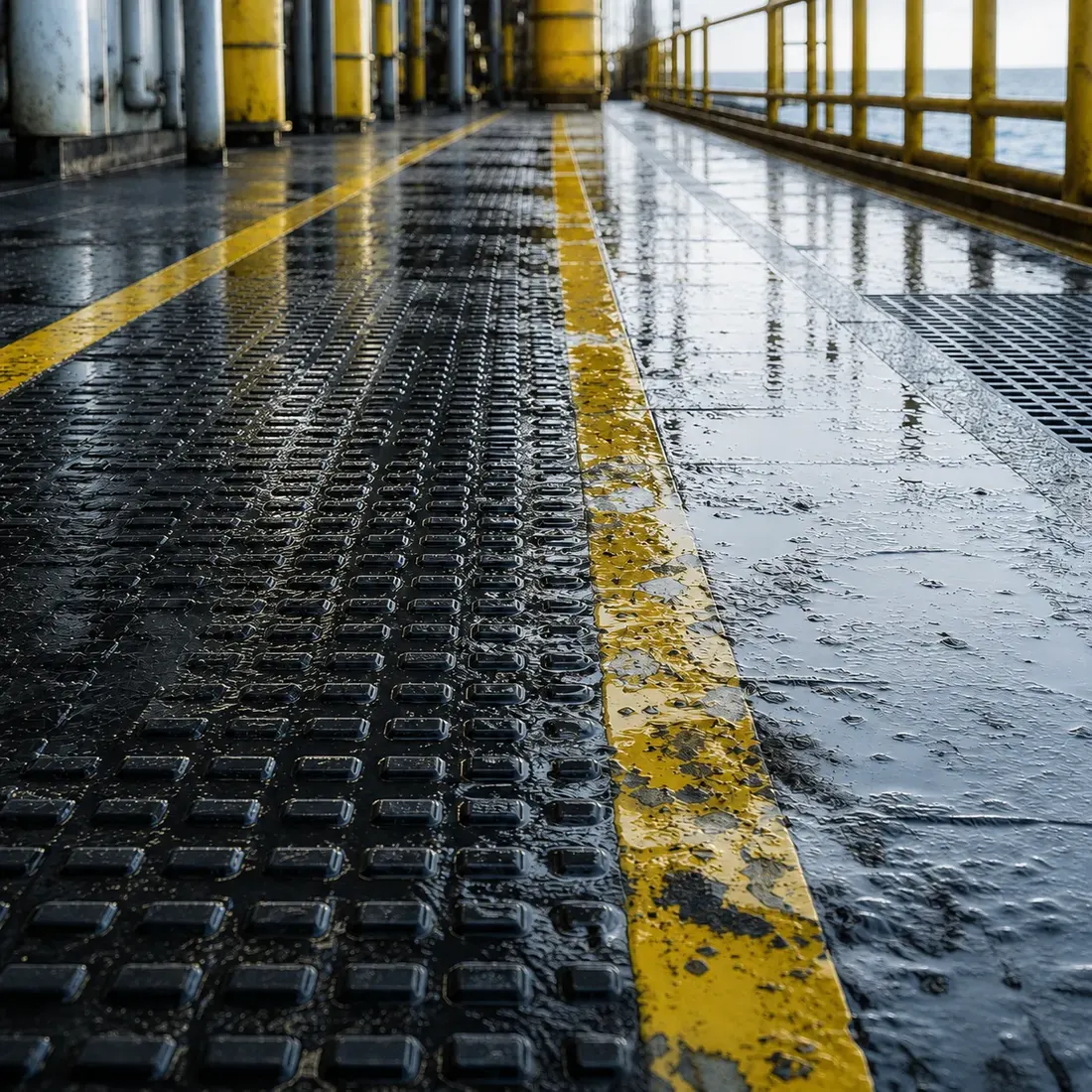
Injured by an Unsafe Vessel Condition?
An unsafe deck, poor drainage, inadequate lighting, or an unsafe working arrangement may support an unseaworthiness claim for an eligible seaman when the condition makes the vessel not reasonably fit for its intended use and that condition is a proximate cause of the injury, meaning it played a substantial part in bringing the injury about. The fact that an accident happened does not, by itself, establish a claim.
Two things matter at the outset. First, unseaworthiness is a doctrine about the condition of the vessel and its appurtenances, not about whether the vessel could float or make its voyage. Second, the law asks whether the vessel was reasonably fit for the work being done, not whether it was perfect or whether every hazard had been eliminated.
You do not need to know which legal theory fits, who owns the vessel, or whether the condition had been reported before to ask for a review. Describe what the deck, the lighting, or the job looked like when you were hurt. That is where an unsafe vessel condition review starts, and the closing section below lists the handful of facts that are enough to begin. The firm's broader unseaworthiness claims practice is described on the main unseaworthiness page; what follows focuses on the conditions themselves.
Working Aboard a Vessel Does Not Automatically Make This Your Claim
The unseaworthiness remedy belongs to seamen. Being on a vessel when you were injured does not make you a seaman, and being employed by a marine company does not either. Seaman status depends on your duties and your connection to a vessel or identifiable fleet of vessels in navigation. The threshold framework comes from the Supreme Court's decision in Chandris, Inc. v. Latsis, 515 U.S. 347 (1995), and it is a fact-intensive test that we address in detail on the page covering whether you qualify as a seaman.
Workers whose injuries fall under the Longshore and Harbor Workers' Compensation Act are in a different position. Under 33 U.S.C. § 905(b), a covered longshore or harbor worker injured by the negligence of a vessel has a vessel-negligence claim, but that statute excludes liability based on the warranty of seaworthiness. A slippery deck can still be legally significant for those workers, but it is analyzed under a negligence framework, not the seaworthiness standard described on this page. See vessel negligence claims for longshore workers.
The responsible party can also differ from the company that pays you. The duty to provide a seaworthy vessel runs from the vessel owner, or from a party operating as owner pro hac vice under certain charter arrangements. A crew member employed by one company and assigned to a vessel owned or chartered by another may have an unseaworthiness claim against an entity other than the employer. Not every charterer bears this duty, and sorting out who does requires looking at the actual ownership and charter documents rather than the name on your paycheck.
If you are not sure where you fit, do not disqualify yourself. Tell us what you did day to day, which vessels you worked on, who employed you, and what vessel you were on when you were hurt. Those facts, not a label, determine the remedy.
When a Slippery or Unsafe Deck May Support an Unseaworthiness Claim
A deck is an appurtenance of the vessel. If its actual condition made it not reasonably fit for the work the crew was expected to do on it, that condition can constitute unseaworthiness. The leading authority is Mitchell v. Trawler Racer, Inc., 362 U.S. 539 (1960), in which the Supreme Court held that the shipowner's duty is absolute and independent of negligence, and that it extends to temporary conditions, not only permanent defects in the vessel's structure.
The legal question is always the same, but the facts that answer it vary by the kind of condition involved. Below are the categories this page covers, with the facts a lawyer would want to establish for each. None of these is an automatic violation. Each is a starting point for asking whether the surface was reasonably fit for the task at hand.
Contamination: oil, grease, hydraulic fluid, drilling mud, fish slime, debris
The questions are what the substance was, where it was, how it got there, how long it had been there, and whether it was on a surface crew members had to use for the assigned task. A film of hydraulic fluid on the deck beside a winch that a deckhand must work at is a different fact pattern from a small spill in an area no one was assigned to enter. A lawyer will also want to know whether the substance was visible, whether cleanup materials were available and used, and whether the vessel's operations routinely deposited that substance in that location.
Standing water and drainage
Vessels get wet. That alone proves nothing. The relevant facts are whether water accumulated because scuppers, drains, or freeing ports were clogged or inadequate; whether the deck was designed to shed water and did not; whether the pooling was in a work area or walkway that had to be used; and whether the water concealed or combined with another hazard, such as residue or a raised fitting. Weather, sea state, and the vessel's motion at the time are part of the picture, but heavy weather does not excuse a drainage system that did not work.
Worn traction surfaces and walking surfaces
Non-skid coatings wear down. Deck plating corrodes. Grating loosens or develops gaps. Raised lips, cable runs, and fittings become trip points when they are in traffic lanes. The question is whether the surface where you had to work or walk provided reasonable footing for the intended use. A lawyer will ask precisely where the worn area was, what task required you to be there, whether alternative routes existed, and what the surface looked like compared with adjacent areas that were maintained.
Inadequate lighting
A hazard that would be avoidable in daylight can become unreasonably dangerous when work continues at night or in an enclosed space with burned-out or missing fixtures. The facts that matter are the lighting actually available at the location and time of the injury, whether work was expected to proceed there in those conditions, whether portable lighting was provided, and whether reduced visibility contributed to the mechanism of injury.
Obstructed walkways and housekeeping
Lines, hoses, tools, cargo, and stored materials left in passageways or on working decks can make an otherwise fit surface unfit for its intended use. The analysis looks at whether the obstruction was part of the ordinary and unavoidable working condition of the vessel, whether a clear route existed, and whether the crew was expected to move through that space carrying loads or in low light.
For every category, the analysis considers the whole situation: the vessel's movement, the weather, the footwear provided or required, the visibility, and the walking routes actually available. No single fact decides the outcome. Being told to wear the boots you had on, or working during a swell, does not by itself convert a hazardous deck into a reasonably fit one, and it does not by itself shift fault to you.
Broken ladders, gangways, winches, cranes, mooring lines, and missing safety gear are covered under defective vessel equipment, because equipment failures raise their own proof questions. The full doctrine, including how unseaworthiness differs from Jones Act negligence and how damages are measured, is on the page covering unseaworthiness doctrine.
A Temporary Hazard Can Matter Even Without Prior Owner Notice
Workers frequently assume they have no claim because the spill was recent or because no one had complained about the condition before. That assumption imports a premises-liability rule that does not govern unseaworthiness.
A temporary unsafe condition may support an unseaworthiness claim, and the vessel owner's notice of the condition is not an element of that claim. The worker must still establish that an unseaworthy condition existed and that it was a proximate cause of the injury. A recent accident proves neither on its own.
Mitchell v. Trawler Racer addressed exactly this scenario. The condition at issue was a temporary one, and the Court held that the owner's duty to furnish a seaworthy vessel does not depend on how long the condition existed or on whether the owner knew or should have known about it. The duty is absolute, and it is not a duty of due care.
How long a condition existed and whether it made the vessel unfit are separate questions. A condition present for five minutes can render a deck not reasonably fit for its intended use. A condition present for five years may not, if it never made the work surface unreasonably dangerous for the task being performed. Keep the two questions apart.
That said, prior complaints, inspection entries, and earlier incidents are still worth looking for. They are not required to prove the claim, but they are often powerful evidence of the condition. A log entry recording a recurring hydraulic leak at a particular station, or a safety meeting note about pooling water aft, helps establish what the deck actually looked like, undercuts arguments that the worker imagined or exaggerated the hazard, and can bear on separate negligence issues. The absence of prior complaints does not defeat a claim, because notice is not something you have to prove. But the evidence that does exist still has to carry the condition and its causal role, so a claim without prior complaints is proved through other means: witnesses, records, photographs, and your own contemporaneous account.
One more distinction, developed further below: a temporary condition is different from an isolated negligent act. The former can be unseaworthiness. The latter, standing alone, is treated differently.
Poor Maintenance Matters Through the Unsafe Condition It Leaves Behind
A worker who says "the boat was badly maintained" is describing something real, but that general statement does not carry a claim. Unseaworthiness is proved through the specific condition that existed at the place and moment of injury and through its causal connection to the harm. Maintenance history matters because it explains and corroborates that condition.
Because the duty does not depend on negligence or notice, you do not have to prove that the owner negligently skipped a maintenance task, or that the owner knew about the resulting hazard, to establish unseaworthiness. What you have to prove is the condition and its causal role. Maintenance records are a tool for doing that, not a separate element to satisfy. Deck coating schedules, repair work orders, drain and scupper inspections, lighting replacement records, and leak histories each pair with a particular kind of condition; the evidence table later on this page lays those pairings out.
Dates, exact locations, and recurrence are what make these records useful. A general entry that "deck was inspected" tells us little. An entry three weeks before your injury noting worn non-skid at the same frame where you fell tells us a great deal. When a lawyer requests these records, the aim is to reconstruct the deck as it existed when you were hurt, not to catalog every shortcoming aboard.
A discrete piece of equipment that failed, such as a ladder rung, a gangway, or a winch brake, is analyzed under defective vessel equipment; that page addresses how equipment failure is proved. And the word "maintenance" in this section refers to vessel upkeep. It is unrelated to the maintenance and cure benefits an injured seaman is owed during recovery, which are a separate obligation with a separate set of rules.
Unsafe Work Method or Isolated Mistake? The Distinction Matters
Nothing has to break for a vessel to be unseaworthy. The way a job is arranged can itself be the unsafe condition. But not every negligent act by a crew member makes the vessel unseaworthy, and the line between the two has been drawn by the Supreme Court.
An unsafe method of work may create an unseaworthy condition. An isolated act of operational negligence, by contrast, is not automatically unseaworthiness. Which side of that line a given incident falls on depends on the working arrangement and the sequence of events, and it requires careful factual and legal review.
In Usner v. Luckenbach Overseas Corp., 400 U.S. 494 (1971), the Court held that a single negligent act by a fellow worker during an otherwise properly conducted operation, using fit equipment, did not render the vessel unseaworthy. The condition of the vessel had not changed; one person made one mistake. (Usner arose in a longshore setting before the 1972 amendments to the Longshore Act, and it should not be read to describe who can bring an unseaworthiness claim today. Its continuing significance is the condition-versus-act distinction.)
The distinction is not a simple rule that repeated acts count and single acts do not, and it does not turn on how recently the act occurred. Courts look at whether the arrangement of the work, as actually practiced, made the vessel unfit for the task, and at whether the act left behind a physical hazard. Consider two hypothetical situations, offered for illustration only:
Hypothetical A — unsafe working arrangement. A crew is instructed to transfer supplies across a wet, unlit stern deck at night with no designated route, no cleared path, and no spotter, because the vessel's standing practice is to complete transfers regardless of conditions. A deckhand falls carrying a load. The arrangement itself, as the vessel routinely conducted the work, is what a lawyer would examine as a potential unseaworthy condition.
Hypothetical B — isolated negligent execution. The same transfer is conducted in daylight on a clean, lit deck, under a procedure with a clear route and adequate crew. As two crew members pass a crate hand to hand, one misjudges the timing and releases it before the other has a grip, and the load comes down on the receiving worker's hand. Nothing about the deck, the equipment, or the way the job was arranged changed; one act of execution went wrong. That is closer to the Usner scenario and would more likely be analyzed as negligence rather than unseaworthiness.
Note what separates the two. If a negligent act leaves a hazard behind, such as a line dropped across the walkway that a coworker later trips on, the resulting obstruction is a condition that is evaluated on its own terms, even though a single act created it moments earlier. The question is never simply who did what and how recently; it is whether the vessel, its appurtenances, or the working arrangement was in fact unfit for the task when the injury occurred.
Real incidents are rarely this clean, which is why the evidence matters: written instructions, the job safety analysis or task plan if one existed, the actual practice aboard as opposed to the written procedure, the workspace configuration, the sequence of events, and who directed what. A lawyer compares what the paperwork says the job should have looked like with what it looked like on the deck.
The same incident can also raise Jones Act employer-negligence issues under 46 U.S.C. § 30104. An unsafe method that does not rise to unseaworthiness may still be employer negligence, and many claims proceed on both theories. The two have different standards and different defendants can be involved. The employer-negligence analysis of unsafe work methods and employer negligence, including training and fatigue, is on its own page, and questions about the competence or size of the crew are addressed under unsafe or inadequate crew.
What to Preserve After an Unsafe-Condition Injury
Decks get washed down, spills get wiped up, and work arrangements change by the next watch. Evidence of an unsafe condition can disappear within hours. The steps below are practical, and they come with a firm caveat: your safety and your medical care come first. Do not go back into a hazardous area, delay treatment, or put yourself at risk to document a scene.
What you can do yourself, lawfully and safely:
- Get medical attention and describe accurately how the injury happened, including the surface condition. Your first medical records often become the earliest independent account.
- Report the incident to the vessel and your employer. State the facts as they were: the substance, the water, the lighting, the obstruction, or the way the job was set up. Do not minimize the condition to avoid friction.
- Write down, as soon as you can, the exact location on the vessel, the date and time, what task you were performing, what the surface looked like and felt like, the lighting, the weather and vessel motion, what footwear you had on, and who was nearby.
- Note the names of every crew member who saw the condition or the incident, or who cleaned the area afterward.
- If photographs can be taken safely and without entering a restricted or dangerous area, take them, including wider shots that show location.
- Keep copies of anything you are given: incident reports, statements you signed, medical paperwork, and written communications about the injury.
What you should not do:
- Do not take records that you are not authorized to have. Counsel can request records through proper channels.
- Do not alter, move, or clean the scene for the purpose of documenting it.
- Do not delay care to gather evidence. Treatment records are themselves evidence.
What counsel may seek through preservation requests and discovery:
| Condition | Records and evidence a lawyer may pursue |
|---|---|
| Contamination or recurring residue | Cleanup and housekeeping logs, spill and leak reports, hydraulic system repair history, deck camera footage, crew statements |
| Standing water | Drain and scupper inspection entries, reports of clogged freeing ports, recurring pooling complaints, weather and sea-state data, deck logs for the watch |
| Worn or unsafe surfacing | Deck coating schedules, repair work orders, shipyard work lists, deferred-repair lists, prior inspection findings, photographs before repainting |
| Inadequate lighting | Lighting inspection and fixture replacement records, work orders, requests for lighting that were not filled |
| Unsafe work method | Written procedures, job safety analyses, task plans, safety meeting minutes, supervisor communications, radio or email traffic |
Whether any of these records exist, and whether they can be obtained, varies from vessel to vessel. Counsel evaluates what to request and how to preserve it; there is no promise that a particular record will be available.
Preservation urgency is not the same thing as a legal filing deadline. General maritime personal injury actions are generally subject to a three-year limitation under 46 U.S.C. § 30106, but exceptions and special rules for certain defendants exist, and the applicable period should be reviewed for your specific facts as early as possible. The unseaworthiness claims overview and an individual consultation are the places to address timing.
Company Blame, a Cleaned Deck, and Missing Photos: Does Review Still Make Sense?
Company blame, a cleaned deck, or missing photographs does not by itself decide whether a claim is viable. The available evidence and the applicable law have to be evaluated, and any question of worker fault requires its own analysis.
The deck has already been washed, repaired, or repainted. Is it too late to ask?
No. Cleanup is expected, and it does not erase the claim. It changes what evidence a lawyer looks for: witness accounts, the incident report, your contemporaneous medical history, housekeeping or repair entries that reflect the cleanup itself, records from before the incident that describe the area, and any footage or photographs taken by others. The fact that the area was cleaned or repaired afterward does not itself establish liability, and whether that fact can be used, and for what purpose, depends on the applicable evidence rules. None of this guarantees proof, but a cleaned deck is a reason to move quickly, not a reason to stay silent.
I did not take photographs. Does that end it?
No. Photographs are useful, but they are not a prerequisite for a case review or for a claim. Many unsafe-condition claims are proved through testimony, vessel records, and medical documentation. Tell us what you remember while it is fresh and let counsel evaluate what else may exist.
The company says I should have watched my step, or that it was my job to clean the area.
Being told you should have been more careful does not resolve the claim. Under general maritime law, a seaman's own fault is treated as comparative fault: it may reduce recovery in proportion to the seaman's share of responsibility, but it does not by itself eliminate the claim. Knowing a hazard existed does not automatically make the injury your fault, particularly where the work had to be done in that location and no reasonable alternative was provided. An assignment to clean a recurring hazard can itself be part of the working-arrangement analysis. Every one of these points requires a specific look at the facts, and the company's version of events is exactly that: a version.
I am worried about my job and my benefits.
That concern is reasonable, and we do not promise that pursuing a claim carries no workplace risk. What we can say is that questions about your immediate income and medical care during recovery are governed by the separate obligation of maintenance and cure benefits, which does not depend on proving an unsafe condition and which is not conditioned on your giving up other claims. How damages are measured on an unseaworthiness claim, and how it interacts with a Jones Act negligence claim, is covered on the page explaining how unseaworthiness differs from Jones Act negligence.
Legal Sources for This Page
The explanations on this page rest on identifiable authority. They are general legal information, and they cannot determine whether any individual worker has a claim.
- Reasonable fitness, temporary conditions, and the absence of a notice requirement: Mitchell v. Trawler Racer, Inc., 362 U.S. 539 (1960).
- Unseaworthy condition versus isolated operational negligence: Usner v. Luckenbach Overseas Corp., 400 U.S. 494 (1971), cited only for the condition-versus-act distinction, not for who may bring a claim today.
- Seaman status threshold: Chandris, Inc. v. Latsis, 515 U.S. 347 (1995), with the detailed analysis maintained on the seaman-status page.
- Longshore workers and vessel negligence: 33 U.S.C. § 905(b).
- Jones Act employer negligence: 46 U.S.C. § 30104.
- General maritime limitation period: 46 U.S.C. § 30106, subject to exceptions and special rules.
On causation: courts applying general maritime law generally require that the unseaworthy condition be a proximate cause of the injury, one that played a substantial part in bringing it about. That is a more demanding link than the causation standard applied to Jones Act negligence, which is one reason the two theories are pleaded and proved separately. Causation and comparative-fault standards are applied under controlling federal maritime law, including decisions of the United States Court of Appeals for the Fifth Circuit that govern Louisiana and much of the Gulf Coast, and they are applied to the facts of each case. Nothing on this page cites a Coast Guard or OSHA regulation as governing a particular deck condition, because whether a regulation applies depends on vessel class, jurisdiction, and the specific provision. The hypotheticals above are illustrations, not case results. The fuller doctrinal discussion, with its own citations, is on the page covering how unseaworthiness differs from Jones Act negligence.
Ask The Young Firm to Review the Condition That Caused Your Injury
You do not have to identify the correct legal theory, prove that anyone knew about the hazard, or gather the vessel's maintenance records before contacting us. Call or send a message to The Young Firm and start with what you know:
- The vessel you were on and the company you worked for
- Your job and what you were doing at the time
- The date of the incident
- The condition or working arrangement involved: the substance, the water, the lighting, the surface, or the way the job was set up
- The injury and where you have been treated
- The phone number or email where you can be reached, and whether it is safe to leave a message there
That is all the initial review requires. A condition-focused review looks at whether you are likely to qualify for a seaman's remedy or a different framework, which parties may bear responsibility for the vessel's condition, what the condition actually was, how it connects to your injury, what evidence exists or should be preserved, and what deadlines apply to your situation.
Contacting The Young Firm to describe your incident does not by itself create an attorney-client relationship, and no one can promise a particular outcome before the facts are reviewed. When you reach out, ask how consultations and fees are handled so you have clear expectations from the start. General information about the firm's Jones Act and maritime injury practice is on the homepage, and the broader unseaworthiness claims page covers representation across the full range of vessel-condition, equipment, and crew issues. If your injury came from a slippery deck, poor drainage, bad lighting, worn surfacing, deferred upkeep, or an unsafe way of doing the job, this is the place to begin.