
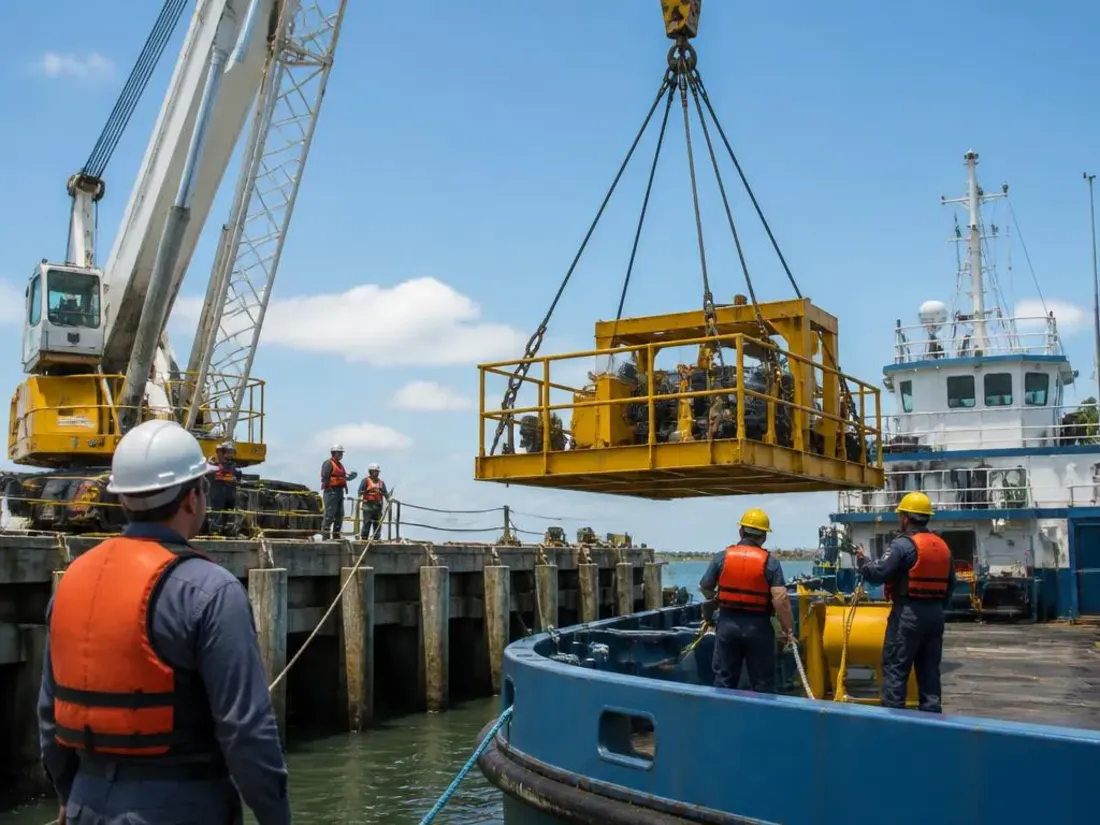
The Young Firm handles Jones Act and maritime injury claims for workers across New Orleans, Louisiana, and the Gulf Coast. This page covers one specific part of that work: bodily-injury claims that may lie against the company that designed, built, supplied, rented, repaired, inspected, or operated the equipment that hurt you. It is not about warranty disputes, repair bills, or recalls that injured no one. It is about whether a company other than your employer had a role in your injury and, if so, how that gets proven.
Two points matter before you read further. First, an equipment failure by itself does not establish that anyone is liable. Second, you do not need to know the manufacturer, the model, or which contractor maintained the equipment before you ask for a review. If you want a maritime product liability lawyer to look at whether the equipment that hurt you was defective or badly serviced, contact The Young Firm with whatever you know now. Finding the rest is what the investigation is for.
This page sits under our broader guide to third-party maritime injury claims, which covers non-employer responsibility more generally. Here, the focus is the equipment itself and the companies behind it.
Can You Sue the Manufacturer if Your Employer Owned the Equipment?
Employer ownership does not by itself rule out a claim against an equipment manufacturer or another equipment company. The question is not whose name is on the asset ledger. It is who designed, built, supplied, maintained, or operated the equipment, whether that party's product or conduct fell short under the law that governs your case, and whether that shortfall actually caused your injury.
Ownership is one role. Design, manufacture, supply, rental, repair, inspection, and operation are different roles, and different companies often fill them. A vessel operator may own a deck crane that a manufacturer built, a service company overhauled last year, a rental yard supplied replacement parts for, and a contractor's crew operated on the day of the accident. Each of those parties can be examined separately.
In plain terms, an equipment claim generally has to establish these things, though the precise legal test depends on the governing law:
- What the product or equipment was. Not "a shackle," but which shackle, from which maker, with which rating, installed when, and possibly modified or rebuilt by whom. Rental, rebranding, rebuilding, and replacement parts can make this harder than it sounds.
- What role the defendant played. A manufacturer's duties differ from a rental company's, which differ from a repair contractor's. Simply having handled the equipment at some point does not make a supplier, rental company, or component maker liable.
- What was wrong. A defect in design or manufacture, an inadequate warning, negligent repair or inspection, or unsafe operation. A product-defect theory focuses on the product itself; a negligence theory focuses on what a company did or failed to do. These are separate theories with separate proof.
- Causation. The defect or negligent conduct has to be connected to your injury. Often that connection runs through a mechanical failure, but equipment that operated exactly as designed can still cause injury if the design or the warnings were inadequate. A part that broke in the accident is not necessarily the part that caused it.
- Injury and loss. Your medical condition, treatment, and the losses that flowed from it.
Your work status, your relationship to the various companies at the site, and the law that governs the incident can all affect which defendants are available. A worker who qualifies as a seaman, a longshore worker covered by the LHWCA, and a contractor's employee on a fixed platform may each face a different landscape even after an identical failure.
Where your own employer's conduct is part of the picture, such as unsafe work methods, training gaps, or a decision to keep using equipment that was known to be worn, that is a separate question addressed under Jones Act employer negligence. How an equipment claim runs alongside employer remedies is covered in third-party claims alongside Jones Act and LHWCA remedies.
Product Defect, Poor Repair, or Unsafe Operation: Different Causes Require Different Proof
Broken equipment does not automatically mean a defective product. It may mean a defective product. It may also mean a sound product that was repaired badly, inspected carelessly, overloaded, or modified after it left the factory. More than one of these can be true at once. Each points to a different company and demands different evidence.
The table below lays out the main possibilities. It is a framework for investigation, not a statement of the legal elements that apply everywhere; the governing law determines the actual tests.
| Suspected problem | Who may be responsible | What the investigation looks for | Caveat |
|---|---|---|---|
| Design defect: the equipment was built as intended but the design itself created an unreasonable hazard | Manufacturer, sometimes a component designer | Design documents, industry standards, feasible safer alternatives, failure pattern consistent with the design | Defect standards differ between maritime law and state law; a dangerous-looking design is not automatically a defective one |
| Manufacturing defect: this unit departed from its intended design or specifications | Manufacturer, component maker | Metallurgical or engineering analysis, comparison to specifications, production records | Requires the actual failed part or reliable evidence about it |
| Inadequate warning or instruction | Manufacturer, sometimes supplier | Manuals, labels, load charts, whether the hazard was known and whether a reasonable warning would have changed the outcome | Warning claims have specific conditions; see the component-part note below |
| Negligent repair or rebuild | Repair contractor, service company | Work orders, invoices, parts used, technician qualifications, post-repair testing | A repairer is not liable for a failure unrelated to its work |
| Poor maintenance or inspection | Maintenance provider, inspector, rental owner, sometimes the operator with maintenance responsibility | Inspection reports, maintenance logs, wear measurements, lubrication and corrosion records | Duties depend on applicable law, contracts, and actual control, not on labels |
| Unsafe operation or rigging | Operator's employer, rigging contractor | Lift plans, load weights, communication, training, weather and sea state, job safety analysis | Operational negligence is a service claim, not a product claim |
Design and manufacturing defects, in plain terms
A manufacturing defect means this particular unit came off the line wrong: a casting with a void, a weld that did not penetrate, a wire rope with a flaw in the strand. The design may have been sound; the execution was not.
A design defect means the unit was built as intended, and the intention was the problem. Units built to that design generally share the hazard. Proving a design defect typically involves showing how the design created the risk and what a safer design would have looked like, but the exact showing required depends on whether maritime law or a particular state's law governs.
These categories can overlap. A single failure may involve a design that left too little margin and a unit that also fell short of that design, and the investigation does not have to choose one theory before the evidence is examined.
Inadequate warnings, including replacement parts
A manufacturer can be responsible for failing to warn about a hazard it knew or should have known about. Under general maritime law, the Supreme Court in Air & Liquid Systems Corp. v. DeVries, 586 U.S. 446 (2019), addressed a manufacturer's duty to warn when its product requires incorporation of a part, the manufacturer knows or has reason to know the integrated product is likely to be dangerous for its intended uses, and the manufacturer has no reason to believe users will realize that danger. That is a conditional rule. It does not mean an equipment maker is liable for every replacement component someone later installs, and whether it applies at all depends on maritime law governing the case and on how courts have applied it since.
Why alternative explanations are investigated, not accepted
Companies defending equipment claims often point to corrosion, overloading, a later modification, or a replacement component from another supplier. Each of those is a real possibility. None of them defeats a claim just by being said. Corrosion may itself reflect a maintenance failure or an inadequate material specification. Overloading may reflect a missing or misleading load chart. A modification may have been made by a service company that is itself a potential defendant. The physical evidence decides which explanation holds.
Hypothetical illustration. Two deckhands on different vessels are each struck when a synthetic sling parts during a lift. On the first vessel, the sling is examined and found to have a manufacturing flaw in its core yarn; the manufacturer is the focus. On the second, the sling is sound, but inspection records show it had been in service years past its retirement criteria with visible cuts, and the crew had never been trained on sling inspection; the questions there run to whoever was responsible for inspection and to the employer. Same injury, same appearance at the scene, different defendants. This example is hypothetical and does not describe a case handled by The Young Firm.
How this differs from an unseaworthiness claim
If you are a seaman and defective equipment on your vessel injured you, you may have an unseaworthiness claim against the vessel owner regardless of who manufactured the equipment. That is a separate remedy with its own standards, covered in our guides to unseaworthiness claims and defective vessel equipment. A manufacturer claim asks whether the product was legally defective or the maker's conduct fell short; an unseaworthiness claim asks whether the vessel and its gear were reasonably fit for their intended use. They can coexist, but they are not the same claim.
Non-equipment negligence by contractors, platform owners, and dock operators is addressed separately under contractor and premises negligence.
Can an Offshore Crane Company Be Negligent Even if the Crane Was Not Defective?
Yes. A crane company can be negligent even when nothing about the crane itself was defective. Negligent inspection, maintenance, rigging, or operation within that company's actual responsibility can support an equipment-service negligence claim. But the crane company's name on the boom, or its ownership of the crane, does not by itself establish fault.
Offshore crane incidents commonly involve several companies at once. Sorting out who did what is the core of the investigation.
The roles that get separated, and the questions each raises:
- Manufacturer. Designed and built the crane or its components. Was the crane or a component defective, and were the warnings and load information adequate?
- Rental owner. Supplied the crane under a contract. Did it retain maintenance or inspection duties, and did it actually perform them? The contract and actual practice matter more than the label.
- Maintenance provider. Performed periodic service, repairs, and certification-related work. Was that work done competently, and did it relate to what failed?
- Inspector. Performed required or contracted inspections. Were those inspections adequate, and should they have caught the condition?
- Operator. The person and the company that controlled the lift. Was the lift within capacity, was the lift plan followed, and were conditions safe enough to proceed?
- Rigging contractor. Selected and attached the rigging and communicated with the operator. Did the rigging match the load and the lift?
One company may fill several of these roles. Several companies may each fill one. Which duties each company owed depends on applicable law, its contracts, what it undertook to do, and what it actually did on the day of the incident.
Records that help draw these lines: the crane rental or service agreement; daily and periodic inspection reports; maintenance and repair history; the lift plan and load information; job safety analyses; operator and rigger qualifications; radio or communication logs; and, where the crane has them, electronic load-moment indicator and event logs. Photographs of the crane's configuration and the rigging as found also matter.
Hypothetical illustration. A crane on a production platform drops a load of pipe. In one version, the wire rope failed at a point with a documented manufacturing flaw; the investigation runs to the rope maker. In another version, the rope was fine, but the load exceeded the chart for the boom angle and radius, the operator had no reliable weight for the pipe bundle, and no lift plan existed; the investigation runs to the operating company and whoever was responsible for planning the lift. Nothing about the crane was defective in the second version, yet a company may still be liable. This example is hypothetical and does not describe a firm case.
On regulations and industry standards. Offshore cranes on Outer Continental Shelf facilities are the subject of federal regulation, including 30 C.F.R. § 250.108, which incorporates industry standards. Cranes used in covered longshoring operations are addressed by OSHA at 29 C.F.R. § 1918.66. Whether either applies to your incident depends on the regulator with jurisdiction, the type of facility or activity, and the version of the rule in force on the incident date. Even where a regulation applies, a violation does not by itself resolve liability; the legal effect a violation carries depends on the governing law and has to be reviewed for the specific case. These rules are leads for investigation, not shortcuts to a result.
This section deals with why a particular equipment company might be responsible. Broader crane-incident scenarios and injury types are covered under offshore crane accidents and other injury scenarios, and platform or contractor duties unrelated to equipment are covered under contractor and premises negligence.
What to Preserve Before Failed Equipment Is Repaired, Returned, or Discarded
Your priorities, in order: get medical care, stay safe, keep what you already lawfully have, and tell a lawyer promptly if you know the equipment is about to be repaired, moved, returned, or scrapped. Do not remove parts, enter restricted areas, or test failed equipment yourself.
Equipment evidence can disappear quickly. A failed sling gets thrown in a dumpster. A crane gets repaired and returned to service because the job has to continue. A rental unit goes back to the yard and is issued to another customer. None of this is necessarily improper, but once it happens, the ability to examine the actual failed component may be gone.
What you may already have or be able to write down
- The date, time, and location of the incident, including the vessel, platform, or facility name.
- A description of the equipment: type, approximate size, color, any markings, tags, or serial numbers you noticed or already photographed.
- Photographs or video you took lawfully and safely, or that coworkers sent you.
- Names and contact information for coworkers who saw the incident or worked with the equipment.
- Any incident report, statement, or form you were given or asked to sign.
- Text messages, emails, or radio-log references about the equipment's condition before or after the failure.
- Your medical records, discharge paperwork, and prescriptions.
- Your own account, written down while it is fresh, of what you saw, heard, and felt.
What counsel may need to request from others
- The failed component itself and any mating parts.
- Equipment manuals, load charts, and manufacturer labels.
- Inspection certificates and periodic inspection records.
- Maintenance logs, repair invoices, and parts records.
- Rental or service contracts.
- Lift plans, job safety analyses, and permits to work.
- Electronic logs from the equipment, where they exist.
- Internal investigation reports and root-cause analyses.
These are things a lawyer can seek through preservation requests to the employer, vessel owner, rental company, or contractor; through chain-of-custody arrangements so the failed part can be authenticated later; through coordinated joint inspections; and, where warranted, through controlled testing under agreed protocols. Whether each step is available or necessary depends on the case. None of them is guaranteed, and none happens automatically.
What not to do
Do not go back into a restricted or hazardous area to photograph or retrieve anything. Do not remove parts or take equipment. Do not attempt to test or disassemble the failed item. Do not interfere with your employer's safe operations. Evidence collected that way can hurt you, and the injury risk is real.
If you know the equipment is scheduled for repair, return, sale, or disposal, say so when you contact a lawyer. That information changes how quickly a preservation request needs to go out.
How an Equipment Investigation Tests Claims of Misuse, Wear, or Modification
Companies defending equipment claims may argue that the worker did something wrong: overloaded it, used it for the wrong purpose, ignored a warning, bypassed a safety device. They may also argue that the equipment was fine when it left their hands and someone else wore it out or changed it.
A useful investigation does not assume either the worker or the manufacturer is at fault. It tests each competing explanation against the evidence.
The general sequence looks like this:
- Identify the equipment and the companies. Model, serial number, ownership, rental status, service history, and every company that touched it. Rebranding, rebuilding, and replacement parts can mean the name stamped on the housing is not the name on the part that failed.
- Preserve what can be preserved. Written requests, chain-of-custody protocols, and, where the equipment is in another party's hands, arrangements for access.
- Obtain the records. Manuals, inspection and maintenance history, contracts, lift plans, and any electronic data.
- Assess expert needs. Depending on the failure, that may mean a metallurgist, a mechanical engineer, a crane and rigging specialist, a hydraulics expert, or a human-factors specialist. Not every case needs every expert, and expert selection depends on what actually failed.
- Evaluate causation under the governing law. Connect the identified problem to the injury, and evaluate the defenses.
A part that broke may not be the part that caused the accident. When a load drops, several things break on the way down. Failure analysis distinguishes the initiating failure from secondary damage. That distinction can decide whether the defendant is the rope maker, the hook maker, the operator, or nobody in the supply chain.
Testing. Nondestructive examination, such as visual, dimensional, and certain imaging methods, can often be done without altering the evidence. Destructive testing, such as sectioning a component to examine its metallurgy, permanently changes it and is typically done only under an agreed protocol with all interested parties present or notified. Whether either is appropriate is a fact-dependent decision.
Comparative fault and modification. If a defendant argues you misused the equipment, the answer depends on the evidence and on the governing law. Under general maritime law, a worker's own negligence generally reduces recovery in proportion to fault rather than eliminating it, but the treatment of comparative fault, misuse, and post-sale modification can differ under state products-liability statutes and can vary in how it applies to different theories and defendants. Blame directed at you is not irrelevant, and it is not conclusive. What a lawyer can do is examine whether the alleged misuse was foreseeable, whether it was invited by inadequate instructions or a missing safety feature, and whether it actually contributed to the failure.
Vessel, Dock, or Fixed Platform: Why the Location Can Change the Equipment Claim
An equipment injury is not automatically governed by maritime products-liability law because it happened offshore or near the water. Where you were, what structure you were on, what work you were doing, and who employed you all bear on whether general maritime law or a state's products-liability law supplies the rules.
General maritime law recognizes products-liability claims. The Supreme Court's decision in East River Steamship Corp. v. Transamerica Delaval Inc., 476 U.S. 858 (1986), is the foundational authority, recognizing products liability under admiralty law. The same case limited recovery for a product that damages only itself and causes purely commercial economic loss. That limitation is about commercial losses; it does not bar a worker's claim for bodily injury.
But whether maritime law governs your claim is a threshold question. Very generally:
- Injuries aboard a vessel in navigation are the most likely to fall within maritime jurisdiction.
- Injuries on a fixed offshore platform on the Outer Continental Shelf raise the Outer Continental Shelf Lands Act, 43 U.S.C. § 1333, which extends federal law to those structures and adopts the law of the adjacent state as surrogate federal law to the extent it is applicable and not inconsistent with federal law. Whether that adjacent-state law or maritime law governs a particular platform equipment claim is a fact-specific analysis, not a default.
- Injuries on docks, terminals, and in shipyards may or may not fall under maritime jurisdiction depending on the location and the nature of the activity.
These are inputs to a legal analysis, not outcomes. A "platform" that is actually a jack-up rig may be a vessel. A vessel moored to a dock may or may not change the analysis depending on what was happening.
Living in Louisiana or hiring a New Orleans lawyer does not itself make the Louisiana Products Liability Act govern your case. State products-liability law applies only when the jurisdictional and choice-of-law analysis leads there.
Why this matters: the governing law shapes the defect standard, which defendants are available, which defenses apply, what damages are recoverable, and what deadline governs. Two workers hurt by identical equipment, one on a supply boat and one on a fixed platform, may have materially different claims.
For the broader offshore context, see offshore injury claims. For the general framework on non-employer defendants, see third-party maritime injury claims.
An Equipment Claim May Be Separate from Employer Benefits or Vessel Claims
A claim against an equipment manufacturer or service company may coexist with your other maritime remedies. It is not the same as a Jones Act claim, a maintenance and cure claim, an LHWCA benefits claim, or a vessel-negligence claim. Whether you can pursue both, how they interact, and what a settlement of one does to the other require case-specific review.
Briefly, the neighboring remedies and how they differ:
- Jones Act negligence runs against the employer for the employer's negligence; the manufacturer is not the defendant. See Jones Act claims.
- Maintenance and cure is owed by the employer regardless of fault; it is not a claim against an equipment company. See maintenance and cure claims.
- LHWCA benefits are no-fault compensation from the employer or its carrier for covered workers. See Longshore Act benefits and claims.
- Unseaworthiness runs against the vessel owner for an unfit vessel or gear. See unseaworthiness claims.
- LHWCA Section 905(b) vessel-negligence claims run against the vessel, not the equipment manufacturer.
A manufacturer or equipment-service claim is a separate tort claim against a separate defendant. Receiving maintenance and cure or LHWCA benefits does not, by itself, resolve or waive it. But the interaction cuts both ways. For LHWCA-covered workers, 33 U.S.C. § 933 addresses third-party claims and contains conditions, including requirements around settlement approval, that can affect continued benefits if they are not followed. Employer and carrier reimbursement rights, credits against future benefits, and the timing of a third-party suit can all come into play.
For that reason, do not sign a release or accept a settlement from any equipment company, insurer, or contractor without having it reviewed. A settlement that looks favorable on its face can affect related claims and benefits.
We cannot promise that pursuing a manufacturer means your employer stays out of it, that your benefits will be uninterrupted, or that your job is protected. Those are legitimate concerns, and they are questions for a consultation, not for assurances on a web page.
The detailed treatment of concurrent claims, reimbursement, credits, and settlement approval is in third-party claims alongside Jones Act and LHWCA remedies.
What Compensation Might Be Available, and How Long Do You Have to Act?
What losses can an equipment claim address?
Potentially recoverable losses in a bodily-injury claim against an equipment manufacturer or service company generally include past and future medical expenses, lost earnings, reduced earning capacity, and pain and suffering. Each is subject to the governing law, to proof, and to adjustment for comparative fault where applicable. Payments you have already received from other sources, such as maintenance and cure or LHWCA benefits, may affect the net recovery through reimbursement or credit rules. A settlement range cannot be given from a web page, and punitive damages are not an automatic feature of these claims. Claims arising from a fatal equipment incident involve different remedies and different claimants; see maritime wrongful death claims.
How long do I have to file?
There is no single deadline for every equipment claim. For claims governed by general maritime law, 46 U.S.C. § 30106 provides that a civil action for personal injury or death arising out of a maritime tort must be brought within three years after the cause of action arose, "except as otherwise provided by law." That statutory qualification matters: the three-year period is not a universal deadline, and where a claim is governed by state law rather than maritime law, different periods may apply. State products-liability claims carry their own prescription or repose periods, some considerably shorter, and those periods depend on the state whose law applies and the incident date. Claims involving government entities or certain defendants can carry additional notice requirements.
Two further points. Contacting a law firm, sending an intake form, or having a preservation letter go out does not file a lawsuit and does not stop any deadline. And the legal deadline is separate from the practical one: equipment evidence can be repaired, returned, or discarded long before any statute runs. Both clocks matter, and neither can be pinned down without your specific facts.
What if the incident was more than a year ago?
Ask anyway. Whether a claim remains timely depends on the governing law, when the cause of action accrued, and other facts that a lawyer needs to examine. Do not assume you are out of time or that you are safely within it.
For how deadlines and settlements interact with related remedies, see third-party maritime injury claims and third-party claims alongside Jones Act and LHWCA remedies.
Legal Authorities Relevant to Equipment-Injury Claims
The following authorities bear on the questions discussed above. Each is listed with what it is commonly cited for and where its reach ends. How any of them applies to a particular incident depends on the facts and on current controlling decisions, and requires a lawyer's analysis.
| Authority | Commonly cited for | Limits |
|---|---|---|
| East River Steamship Corp. v. Transamerica Delaval Inc., 476 U.S. 858 (1986) | Recognition of products liability under general maritime law | Its economic-loss holding concerns a product that damages only itself and causes commercial loss; it does not bar bodily-injury claims |
| Air & Liquid Systems Corp. v. DeVries, 586 U.S. 446 (2019) | A maritime manufacturer's duty to warn where its product requires incorporation of a part, the manufacturer knows or has reason to know the integrated product is likely dangerous for intended uses, and it has no reason to believe users will realize the danger | Conditional rule in the maritime tort context; not a basis for liability over every later-installed component; later controlling interpretations must be checked |
| 43 U.S.C. § 1333 (OCSLA) | Extension of federal law to Outer Continental Shelf structures and conditional adoption of adjacent-state law | Does not make Louisiana law govern every Gulf incident; application is fact-specific |
| 33 U.S.C. § 933 (LHWCA Section 33) | Coordination of third-party claims with LHWCA benefits, including settlement-related conditions | Applies to LHWCA-covered workers; details belong to case-specific review |
| 46 U.S.C. § 30106 | Three-year limitation for maritime personal-injury torts | Subject to the "except as otherwise provided by law" qualification; a claim governed by state law may be subject to different periods |
| 30 C.F.R. § 250.108; 29 C.F.R. § 1918.66 | Research leads on offshore crane and longshoring crane requirements | Application depends on regulator jurisdiction, facility or activity coverage, and incident-date version; legal effect of a violation depends on the governing law |
The hypothetical illustrations on this page are constructed to show how identical-looking failures can have different causes and defendants. They do not describe cases handled by The Young Firm and are not indications of typical outcomes. Nothing here resolves the law governing any individual incident. That requires facts, records, and a lawyer's analysis.
Ask The Young Firm to Review the Equipment and Companies Involved
Start with what you know. You do not need a manufacturer's name, the failed part, an engineering report, or a legal theory to ask for a review. An incomplete picture is normal at this stage, and it is what the review is for.
When you reach out, it helps to have in mind:
- When and where the injury happened, and what vessel, platform, or facility you were on.
- Your job and who employed you.
- What the equipment was and what it was doing when it failed, as best you can describe it.
- The companies you know were involved: your employer, the vessel or platform owner, any contractors, any rental or service company whose name you saw.
- Your injuries and the treatment you have had so far.
- Any documents, photographs, or messages you already have.
Two things to flag immediately if they apply: equipment that you know is scheduled for repair, return, or disposal, and any release, settlement offer, or document anyone has asked you to sign.
Records you already have are useful, but they are not a condition of contacting us. Do not delay a call because you are still gathering paperwork.
The Young Firm handles Jones Act and maritime injury claims for workers in New Orleans, across Louisiana, and along the Gulf Coast. When you contact the firm, ask about consultation terms, how attorney fees are structured, and how litigation expenses such as expert fees are handled. Attorney fees and litigation expenses are different things, and you should have clear answers on both before you decide anything.
Contact The Young Firm to have the equipment and the companies involved in your injury reviewed. For the broader picture of non-employer responsibility after a maritime injury, see third-party maritime injury claims. For everything else the firm does, start at The Young Firm home page.